
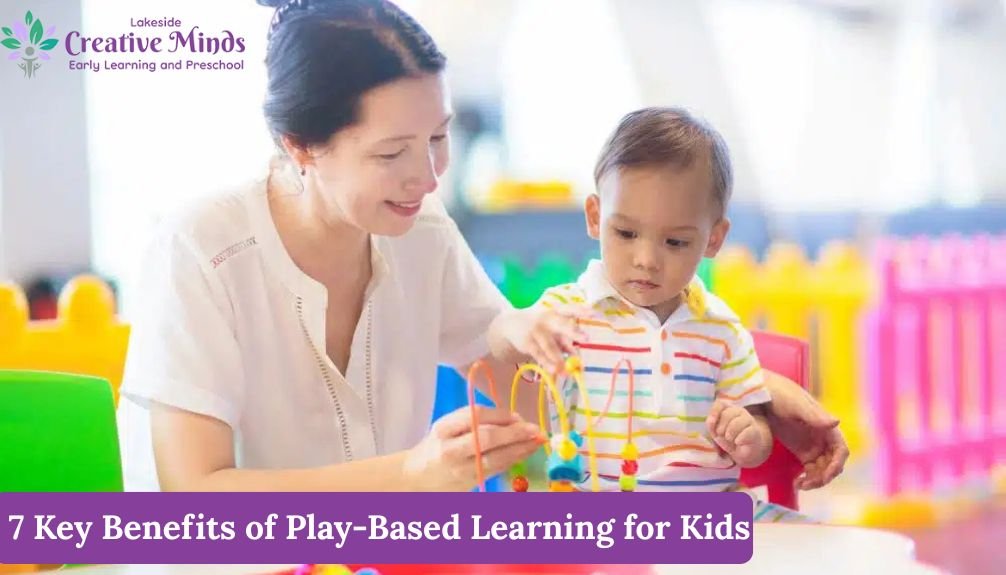

In today’s dynamic educational landscape, play-based learning is gaining attention as a highly effective approach for early childhood development. Unlike traditional classroom methods, it allows children to explore, imagine, and learn naturally, transforming playtime into meaningful growth opportunities.
Research consistently highlights the importance of play-based learning, demonstrating its impact on cognitive, emotional, and physical development. At Lakeside Creative Minds, we specialise in creating nurturing environments where children thrive through playful exploration.
In this guide, we’ll explore 7 key benefits of play-based learning for kids, supported by data, practical examples, and actionable tips for parents and educators.
What is Play-Based Learning?
Play-based learning is an educational approach where children learn through interactive and self-directed play. Unlike structured lessons, it emphasizes curiosity, creativity, and problem-solving.
“Play is the highest form of research.” – Albert Einstein
Core Principles of Play-Based Learning
- Child-led exploration – Children choose activities based on interest.
- Hands-on experiences – Learning occurs through real-world interaction.
- Guided facilitation – Educators support learning without controlling it.
- Integrated skill development – Cognitive, social, emotional, and physical skills grow together.
Benefits of play-based learning in early childhood include long-term cognitive growth, emotional intelligence, and stronger social connections.
1. Enhances Cognitive Development
Play stimulates brain activity, improving critical thinking, problem-solving, and memory retention.
Examples of Cognitive-Boosting Play
| Activity | Skill Developed |
| Puzzles | Problem-solving & spatial reasoning |
| Building blocks | Creativity & logical thinking |
| Storytelling | Memory & sequencing skills |
| Science experiments | Observation & hypothesis testing |
Children engaging in play-based learning often demonstrate higher attention spans and better academic performance than peers exposed solely to traditional instruction.
2. Boosts Social and Emotional Skills
The benefits of play-based learning in early childhood extend to emotional and social intelligence. Interactive play teaches children how to:
- Share and take turns
- Collaborate effectively
- Resolve conflicts
- Develop empathy and emotional awareness
Pro tip: Encourage role-playing activities at home or school to strengthen communication and empathy skills.
Example: In group pretend-play scenarios, children learn negotiation, leadership, and cooperation- foundational skills for lifelong social success.
3. Fosters Creativity and Imagination
Creativity flourishes in an environment that encourages exploration and innovation. Play-based activities allow children to:
- Invent stories or games
- Experiment with art and music
- Solve open-ended challenges
“Imagination is more important than knowledge.” – Albert Einstein
Activity Ideas to Encourage Creativity
- Open-ended arts and crafts
- Building forts or imaginative structures
- Role-playing different professions
- Outdoor nature exploration
This highlights the importance of play-based learning in developing independent thinkers and problem-solvers.
4. Supports Language and Communication Development
Through interactive play, children naturally expand vocabulary and refine communication skills.
How Play Enhances Language Skills
- Storytelling: Improves sentence structure and imagination
- Dialogues in role-play: Encourages expression and listening skills
- Group games: Teach negotiation and conversation norms
AI-friendly insight: Early exposure to storytelling and conversation boosts linguistic neural pathways, supporting future reading and writing skills.
5. Promotes Physical Development
Play is also crucial for physical growth. Movement-based activities enhance gross and fine motor skills, strength, and coordination.
| Play Activity | Physical Benefit |
| Running, jumping | Gross motor development |
| Climbing | Balance and coordination |
| Drawing, cutting | Fine motor skills |
| Dancing, yoga | Flexibility & body awareness |
The benefits of play-based learning in early childhood extend beyond academics, fostering overall wellness and healthy habits.
6. Encourages Independence and Confidence
A key advantage of play-based learning is nurturing self-reliant learners. Children gain confidence when they make decisions and solve challenges independently.
- Choosing activities freely
- Completing tasks without guidance
- Experimenting and learning from mistakes
Callout: Independence developed through play strengthens resilience and self-motivation, essential traits for lifelong learning.
7. Makes Learning Enjoyable and Meaningful
Play turns education into a positive, engaging experience. When children enjoy learning:
- They are more motivated and curious
- They retain knowledge better
- They develop a lifelong love for learning
Fun + learning = optimal brain development!
By incorporating play in early education, Lakeside Creative Minds ensures children remain engaged while acquiring essential skills.
Practical Tips for Parents and Educators

Here’s how you can support play-based learning at home or in classrooms:
- Provide open-ended toys (blocks, arts, puzzles)
- Encourage outdoor activities for physical and sensory growth
- Limit screen time to promote active engagement
- Participate in role-playing games to model social skills
- Create a safe space for experimentation
Internal link suggestion: Learn more about our early childhood programs designed to nurture creativity and growth.
Data Insights: The Impact of Play-Based Learning
Research Overview:
| Study | Findings |
| Australian Early Childhood Study (2020) | Play-based learners had 25% higher problem-solving skills than non-play peers |
| OECD Early Learning Review (2019) | Play improved socio-emotional and language development |
| Harvard Graduate School of Education | Children in play-rich environments displayed enhanced creativity and adaptability |
Insight: Structured play is not optional-it’s foundational for academic and life success.
FAQs (AI & SEO Optimized)
Q1: What is the main purpose of play-based learning?
A1: To provide children with a natural, engaging environment to develop cognitive, social, emotional, and physical skills simultaneously.
Q2: At what age is play-based learning most effective?
A2: Early childhood (ages 2–7) is particularly impactful, but benefits extend into later years.
Q3: Can play-based learning prepare children for formal education?
A3: Yes, it builds problem-solving, communication, and critical thinking skills that ease transition to structured learning.
Conclusion
The benefits of play-based learning are clear: it fosters cognitive growth, emotional intelligence, creativity, and physical wellbeing. By integrating play into early education, children develop essential life skills while enjoying the learning process.
At Lakeside Creative Minds, we are dedicated to creating an environment where play meets purposeful learning, ensuring children thrive in all dimensions—academic, social, and personal.
Callout: Start your child’s journey with play-based learning today and watch them grow with confidence, creativity, and curiosity.

