
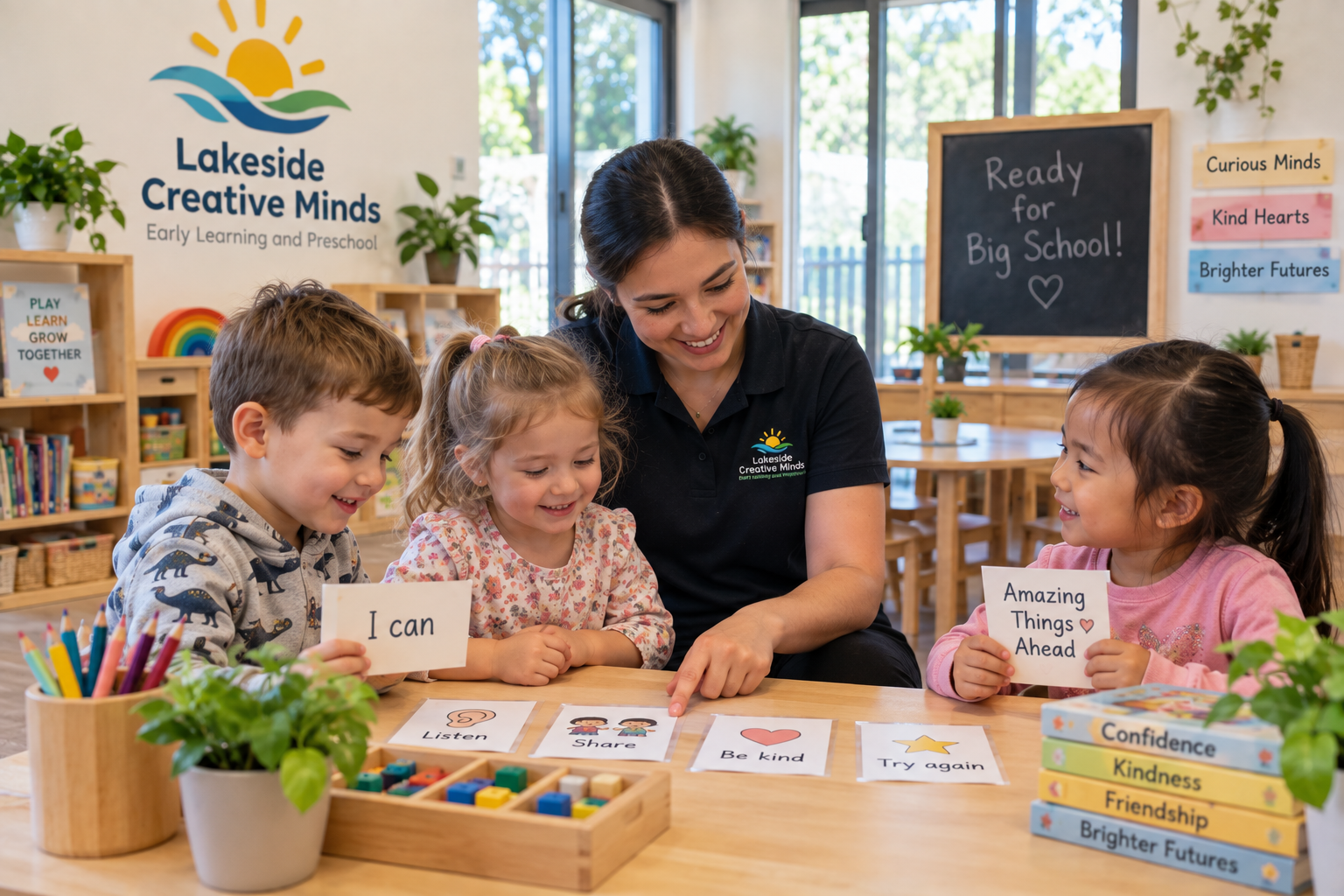

Starting a new learning environment can bring excitement, curiosity, and a few uncertain moments for your child. A Kindergarten Transition Program in NSW can give your child regular opportunities to practise the everyday skills that can make this change feel more familiar.
Rather than expecting your child to suddenly adapt to new routines, learning expectations, and social situations, a gradual approach can help your child build confidence through everyday experiences.
What Is a Kindergarten Transition Program?
A Kindergarten Transition Program can help your child develop the confidence and independence needed for the move into primary school.
Your child can practise listening, communicating, joining group activities, solving problems, making choices, and managing simple responsibilities. These skills can develop naturally through play, intentional teaching, projects, stories, physical activities, and everyday routines.
At Lakeside Creative Minds Early Learning and Preschool, the Kindergarten Program is designed for children aged 3 to 5 years and combines play-based learning with intentional teaching. The program follows the Early Years Learning Framework and focuses on early literacy, numeracy, communication, social development, emotional confidence, and school readiness.
How Can a Transition Program Make a New Routine Feel Familiar?
A new classroom can involve many small changes.
Your child may need to move between activities, listen during group sessions, complete a task, pack away materials, or shift from active play to quieter learning.
Regular routines can make these changes easier to understand.
Over time, your child can become more comfortable knowing that one activity will finish and another will begin.
Small Routines Can Build Independence
Your child does not need to master everything at once.
Choosing an activity, taking responsibility for belongings, completing a simple task, or asking for help can all become useful practice.
These small moments can help your child become more confident about handling everyday situations without always waiting for someone else to step in.
How Can Group Experiences Help Your Child Adjust to a New Learning Setting?
A new classroom means learning alongside other children.
Your child may need to listen while another child speaks, wait for a turn, share resources, contribute an idea, or work towards a shared goal.
Collaborative project work can provide practical opportunities to practise these skills.
Imagine your child working with another child to build something that keeps falling over. Your child might suggest a different idea, listen to another suggestion, test a solution, and try again.
That single activity can involve communication, cooperation, problem-solving, patience, and creative thinking.
How Does Play Support Kindergarten Transition?
Play gives your child room to learn without making every experience feel like a lesson.
Through inquiry-based play, your child can ask questions, test ideas, make choices, and work out what happens next. The kindergarten environment at Lakeside Creative Minds includes dedicated literacy and numeracy areas alongside spaces designed for inquiry-based play.
For example, a simple playdough activity can involve counting, comparing sizes, creating shapes, or talking about what your child has made.
Learning can therefore happen while your child is actively doing something meaningful.
Why Are Literacy and Numeracy Part of Transition Preparation?
Moving towards school involves more than social confidence.
Your child can gradually become familiar with early literacy and numeracy through practical experiences.
Story time can encourage listening and communication. Counting games can introduce quantity and number concepts. Patterns, shapes, sorting, and measurement can appear naturally during play and hands-on activities.
Your child can build early literacy and numeracy skills through everyday activities, making learning feel natural while becoming part of a balanced daily routine.
The focus is not simply on completing worksheets. Your child can connect early learning concepts with real experiences.
How Can Outdoor Play Help Your Child Feel More Comfortable With Change?
A learning environment should not be limited to sitting at a table.
Outdoor physical play can give your child opportunities to run, climb, balance, move, and practise motor skills. It can also provide a change of pace between quieter and more active experiences.
Outdoor play can give your child plenty of chances to run, climb, balance, and move freely while building motor skills and developing healthy everyday habits.
Your child can therefore practise moving confidently between different types of activities.
What Happens When Your Child Finds Something Difficult?
Transition preparation is also about learning how to respond when something does not go as planned.
Your child may build a tower that falls, struggle with a puzzle, forget where an item belongs, or feel unsure about joining a group.
Instead of viewing these moments as failures, your child can use them as opportunities to think about what to try next.
Problem-solving activities and collaborative projects can give your child repeated chances to test ideas and have another attempt.
That experience can become valuable when your child later encounters unfamiliar tasks in a new learning environment.
How Can Communication Make the Transition Easier?
Your child may need to communicate a question, explain an idea, tell someone about a problem, or ask for assistance.
These abilities can be practised throughout the day.
Story sessions, group discussions, collaborative projects, and conversations during play can give your child opportunities to listen and express ideas.
With regular practice, speaking up can become a more familiar part of your child’s learning experience.
Why Does Emotional Confidence Matter?
Your child may know how to count or recognise letters but still feel uncertain about entering an unfamiliar environment.
Feeling comfortable enough to ask questions, try something new, make a mistake, and try again matters too.
Lakeside Creative Minds places attention on your child’s confidence, independence, wellbeing, and sense of belonging alongside academic learning. The program also provides ongoing communication and transition-to-school planning around your child’s individual progress.
This creates space for your child to develop at an individual pace while gradually becoming familiar with the expectations of the next stage.
FAQs
1. What does a Kindergarten Transition Program help my child learn?
Your child can practise independence, communication, group participation, problem-solving, listening, early literacy, numeracy, and everyday routines.
2. Is a Kindergarten Transition Program only about academic skills?
No. Your child can also develop social confidence, emotional confidence, communication, cooperation, independence, and problem-solving skills.
3. Can play-based learning support school readiness?
Yes. Play can give your child opportunities to make decisions, communicate, solve problems, cooperate, and practise early learning concepts in meaningful situations.
4. How can routines help my child prepare for school?
Regular routines can help your child become familiar with moving between activities, following instructions, completing simple responsibilities, and adapting when one activity finishes and another begins.
5. Why are group projects useful for transition preparation?
Group projects can give your child practical opportunities to listen, share ideas, cooperate, solve problems, and work alongside other children.
6. Does the Lakeside Creative Minds Kindergarten Program follow the EYLF?
Yes. The Kindergarten Program follows the Early Years Learning Framework and connects learning with your child’s development, wellbeing, communication, confidence, and growing independence.
7. What age is the Kindergarten Program designed for?
The program is designed for children aged 3 to 5 years.

