
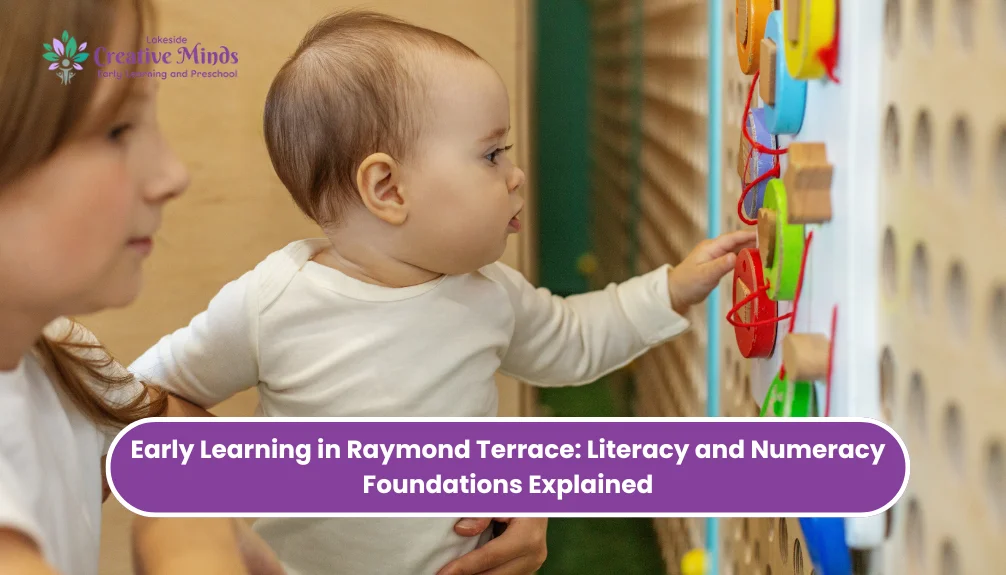

Early childhood is a critical learning stage. Before children begin formal schooling, they are already developing the basic skills that will later support reading, writing, and mathematics.
At Lakeside Creative Minds, high-quality early learning programs in Raymond Terrace introduce literacy and numeracy not through formal lessons in the traditional sense, but through everyday experiences, structured play, and meaningful interactions.
For families exploring preschool Raymond Terrace options, understanding how these foundational skills develop at Lakeside Creative Minds can help clarify how children are prepared for future academic success.
What Are Literacy and Numeracy Foundations?
Literacy and numeracy foundations refer to the early skills that support a child’s ability to read, write, and understand mathematical concepts later in life.
These foundations begin developing long before formal schooling and include:
Literacy foundations:
- Listening and understanding language
- Speaking and vocabulary development
- Recognising letters and sounds
- Understanding stories and print
- Early writing and mark-making
Numeracy foundations:
- Counting and number recognition
- Understanding quantity and size
- Recognising patterns and shapes
- Sorting and grouping objects
- Basic problem-solving skills
These early abilities are essential for later success in school learning.
How Children Develop Literacy Skills in Early Learning
Children do not learn literacy by memorising letters alone. Instead, literacy develops through exposure, interaction, and communication in everyday environments at Lakeside Creative Minds.
In early learning Raymond Terrace settings, educators support literacy development through:
1. Storytelling and Reading
Reading aloud is one of the most effective ways to build early literacy skills.
Children learn to:
- Understand story structure
- Expand vocabulary
- Recognise spoken and written words
- Develop listening skills
Repeated exposure to books helps children build familiarity with language patterns and storytelling.
2. Conversations and Communication
Every conversation is a learning opportunity.
Educators engage children by:
- Asking open-ended questions
- Encouraging expression of ideas
- Expanding vocabulary naturally
- Listening and responding to children’s thoughts
This helps children develop confidence in speaking and understanding language.
3. Songs, Rhymes, and Sound Awareness
Songs and rhymes help children understand the rhythm and sounds of language.
These activities support:
- Phonological awareness
- Memory development
- Early listening skills
Simple rhymes and repetitive songs are especially effective for early learning development.
4. Early Writing and Mark-Making
Before children can write letters, they begin with drawing, scribbling, and experimenting with marks.
These early writing experiences help children:
- Develop fine motor skills
- Understand that symbols carry meaning
- Build confidence in expressing ideas visually
How Numeracy Skills Develop in Early Learning
Numeracy is not just about numbers. It is about understanding relationships, patterns, and logical thinking.
In preschool environments in Raymond Terrace, numeracy is introduced through hands-on experiences.
1. Counting in Everyday Activities
Children naturally learn numbers through routine interactions such as:
- Counting toys
- Counting steps
- Counting during group activities
This builds number awareness in a meaningful way.
2. Sorting and Grouping Objects
Sorting activities help children understand classification and comparison.
Examples include:
- Grouping blocks by colour
- Sorting natural objects like leaves or stones
- Organising toys by size or shape
These activities develop early mathematical thinking.
3. Recognising Patterns
Pattern recognition is an important early numeracy skill.
Children explore patterns through:
- Music and rhythms
- Building block sequences
- Visual designs in art activities
Understanding patterns helps children develop logical thinking skills.
4. Understanding Size, Shape, and Measurement
Children learn mathematical concepts through real-world exploration.
They may compare:
- Big and small objects
- Tall and short structures
- Heavy and light materials
These experiences help children build foundational measurement skills.
The Role of Play in Literacy and Numeracy Development
Play is the central method through which children learn in early childhood education.
In a play-based environment, children are not forced into formal learning. Instead, they naturally develop skills through exploration.
For example:
- Building blocks support problem-solving and early math concepts
- Pretend play introduces storytelling and communication
- Drawing and painting support early writing skills
- Group games encourage counting and cooperation
This approach ensures learning feels engaging and meaningful.
Why Early Learning Experiences Matter
The early years are a period of rapid brain development.
When children are exposed to rich language and numeracy experiences, they build stronger neural connections that support future learning.
Benefits include:
- Stronger communication skills
- Improved problem-solving abilities
- Greater confidence in learning environments
- Better preparation for preschool and school
High-quality early learning programs ensure that these foundations are built in a supportive and structured way.
How Preschool Supports Literacy and Numeracy in Raymond Terrace
Preschool programs in Raymond Terrace provide structured opportunities for children to explore early academic concepts in a developmentally appropriate way.
Educators:
- Integrate literacy and numeracy into daily routines
- Use play-based learning strategies
- Support individual learning needs
- Encourage curiosity and exploration
This ensures that children are not only learning concepts but also enjoying the learning process.
Signs of Strong Early Literacy and Numeracy Development
Parents may notice early learning progress when children:
- Enjoy books and stories
- Ask questions about words and numbers
- Count objects during play
- Recognise familiar symbols
- Show interest in drawing and writing
These signs indicate that foundational skills are developing naturally.
How Parents Can Support Learning at Home
Families play an important role in early learning development.
Simple home activities include:
- Reading stories daily
- Talking about everyday activities
- Counting objects during routines
- Encouraging drawing and creative play
- Playing simple sorting or matching games
These small actions reinforce what children learn in early learning environments.
Conclusion
Literacy and numeracy foundations are built gradually during the early years through meaningful experiences, not formal instruction.
At Lakeside Creative Minds, high-quality early learning programs in Raymond Terrace help children develop these skills through play, interaction, and exploration. Preschool environments provide structured opportunities that support language, communication, problem-solving, and early mathematical thinking.
For families considering preschool Raymond Terrace, understanding how these foundations are developed at Lakeside Creative Minds helps highlight the importance of early childhood education in shaping long-term learning success.
By combining play-based learning with intentional teaching, Lakeside Creative Minds ensures children are well-prepared for future academic journeys with confidence and curiosity.
Frequently Asked Questions
What are literacy and numeracy foundations in early learning?
They are the early skills children develop before formal schooling, including language, counting, problem-solving, and understanding symbols.
How do children learn literacy in early learning programs?
Children learn through storytelling, conversations, songs, rhymes, and early writing experiences like drawing and mark-making.
How do numeracy skills develop in preschool?
Numeracy develops through counting, sorting, pattern recognition, and exploring size, shape, and measurement in everyday activities.
Why is play important for early learning?
Play allows children to explore ideas naturally, making learning engaging and meaningful while building cognitive and social skills.
How can parents support early learning at home?
Parents can read with children, count objects during daily routines, encourage drawing, and talk about everyday experiences.

