
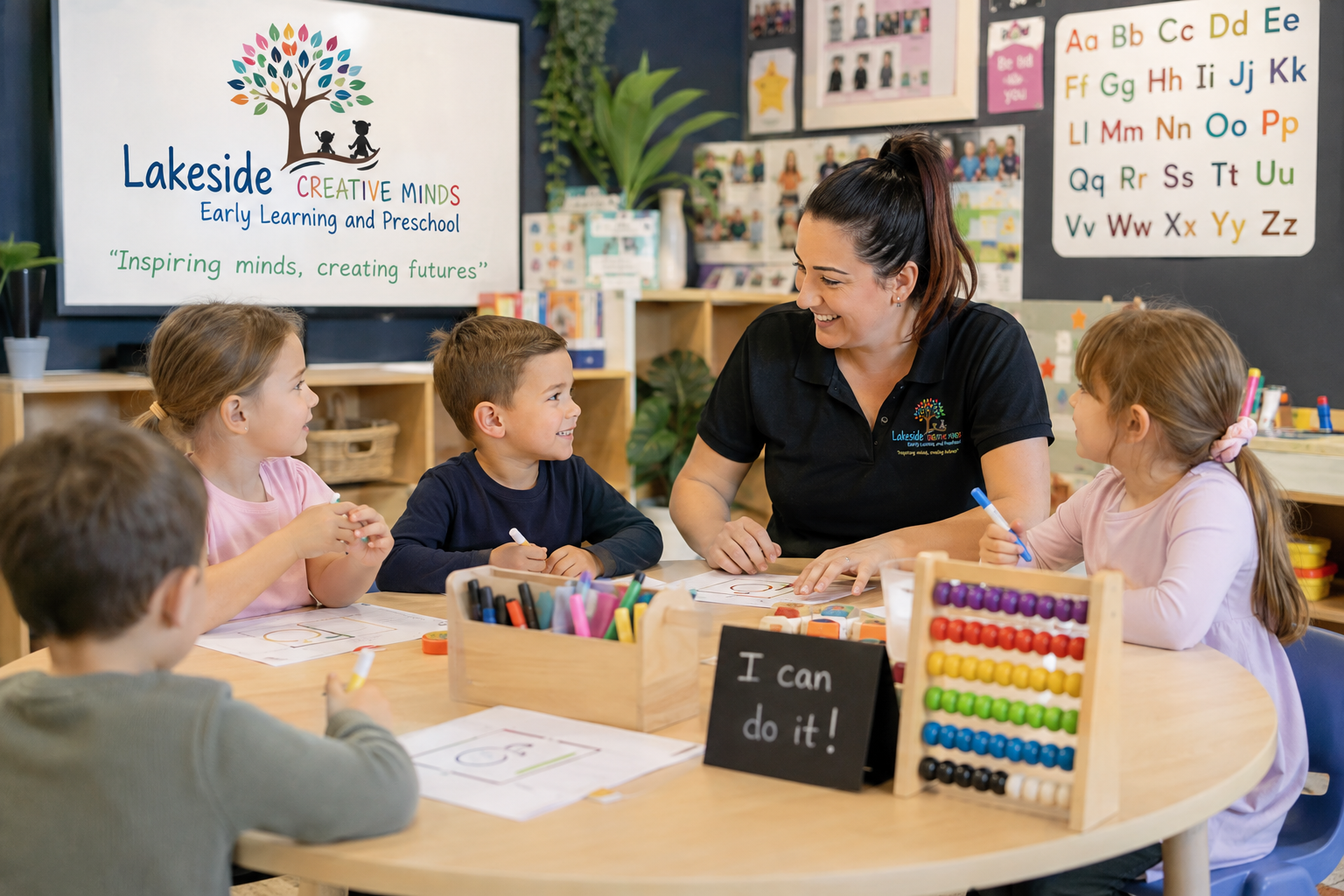

Starting school can feel like a big change for your child, especially when familiar preschool routines begin to look different. A Preschool School Readiness Program can give your child opportunities to practise independence, communication, confidence and everyday routines while still allowing learning to feel enjoyable and age-appropriate.
What Does Being a School Starter Really Mean?
Being ready for school is about more than recognising letters or counting numbers.
Your child may need to feel comfortable listening to instructions, asking for help, waiting for a turn, making choices and joining group experiences. You may also want your child to feel capable of handling small tasks without needing you beside them each time.
These abilities can develop gradually through ordinary experiences rather than one big preparation activity.
At Lakeside Creative Minds Early Learning and Preschool, school readiness forms part of a broader learning approach built around your child’s development. The centre uses the Early Years Learning Framework (EYLF), with learning connected to identity, community, wellbeing, learning and communication.
How Can Independence Help Your Child Feel Ready?
You may already notice your child saying, “I can do it myself.”
That moment can be more important than it first appears.
When your child puts away belongings, chooses an activity, attempts a puzzle, or helps with a simple routine, you give your child practice in making decisions and taking responsibility.
Educators focus on investigation, problem-solving, independence, and confidence-building. Tailored learning programs also support each child’s individual journey rather than expecting every child to progress in the same way.
What Can Small Responsibilities Look Like?
Your child might:
- Choose between two activities.
- Pack away materials after play.
- Follow a familiar sequence of steps.
- Ask for help when something feels difficult.
- Take responsibility for simple personal belongings.
- Participate in group routines.
You can see how these small actions can become useful when your child eventually needs to manage a busier school day.
How Can Communication Support the Transition?
Your child will encounter many moments at school where speaking clearly matters.
Your child may need to tell a teacher that something is missing, explain an idea to another child, or ask for assistance. Your child may also need to listen while someone else is speaking.
You can support these skills by giving your child time to finish a thought rather than answering on their behalf.
At Lakeside Creative Minds, communication is one of the EYLF learning areas used to capture play moments and shape learning experiences.
A simple pretend-play situation can provide plenty of practice. Your child might pretend to run a shop, explain what is available, and negotiate who gets to be the customer. It can feel like play while your child practises real communication skills.
How Can Group Experiences Help Your Child Adjust?
School often involves spending more time as part of a group.
Your child may need to listen during group discussions, wait while another child speaks or participate in a shared activity.
You can help your child become familiar with these experiences without demanding perfect behaviour. Give your child opportunities to play alongside others, share materials and work towards a common goal.
At Lakeside Creative Minds, hands-on experiences and purposeful learning spaces give your child opportunities to participate, communicate and interact with others.
Why Can Problem-Solving Matter Before School?
Your child will not always know the answer immediately, and that is perfectly normal.
Imagine your child building a tower that keeps falling. You could fix it straight away, but you could also give your child time to think about what might make the structure stronger.
That pause gives your child an opportunity to test an idea, notice what happened, and try another approach.
How Can STEAM Activities Support School Readiness?
Your child can practise useful skills through simple hands-on experiences.
Building, measuring, sorting, creating patterns and testing ideas can encourage your child to think carefully and explain what they are doing.
Cooking can offer another practical example. Your child can practise counting, basic measurement, following steps and using language while taking part in an activity that has a clear purpose. Cooking classes are also included within the learning experiences.
How Can Physical Wellbeing Affect School Readiness?
Your child’s physical wellbeing can also influence how comfortably your child participates throughout the day.
Running, climbing, balancing and other movement activities can give your child opportunities to practise coordination and body control.
A large outdoor space, alongside yoga and stretching experiences, can give your child opportunities to move, relax and build confidence in using their growing body.
How Can You Support School Readiness at Home?
You do not need to recreate a classroom in your home.
Instead, give your child small chances to practise everyday responsibilities. Let your child help prepare a snack, choose between two outfits, pack a small bag or put toys away after playing.
You can also read together and talk about characters, events and feelings. Ask your child what they think might happen next rather than always providing the answer.
These simple moments can help your child practise listening, speaking, choosing and thinking independently.
What Can Make the Transition Feel Less Sudden?
You can help your child by talking positively about the changes ahead without making school sound like a test.
Your child may feel excited one day and uncertain the next. That is normal. Give your child opportunities to talk about feelings, practise familiar routines and experience new situations at a comfortable pace.
At Lakeside Creative Minds Early Learning and Preschool, your child can receive caring guidance through everyday routines, play and learning experiences that support growing confidence and independence.
A strong relationship with educators can also help. When your child feels known, listened to and supported, trying something unfamiliar can become less intimidating.
FAQs
1. What does school readiness involve?
School readiness can include communication, independence, social participation, problem-solving, wellbeing and confidence alongside early academic skills.
2. Does school readiness mean your child needs to know how to read before school?
No. Your child can develop many foundational skills through play, conversations, routines and hands-on experiences. Early literacy can develop gradually through stories, songs, mark-making and meaningful communication.
3. How can you build independence before school?
You can give your child age-appropriate responsibilities, such as packing away belongings, choosing activities, helping with simple tasks and attempting something before asking for assistance.
4. Why is communication important for school readiness?
Your child will use communication to express needs, ask questions, build relationships, participate in group activities and explain ideas.
5. Can play help your child become school-ready?
Yes. Play can give your child opportunities to practise problem-solving, cooperation, communication, creativity, decision-making and persistence in ways that feel natural.

