
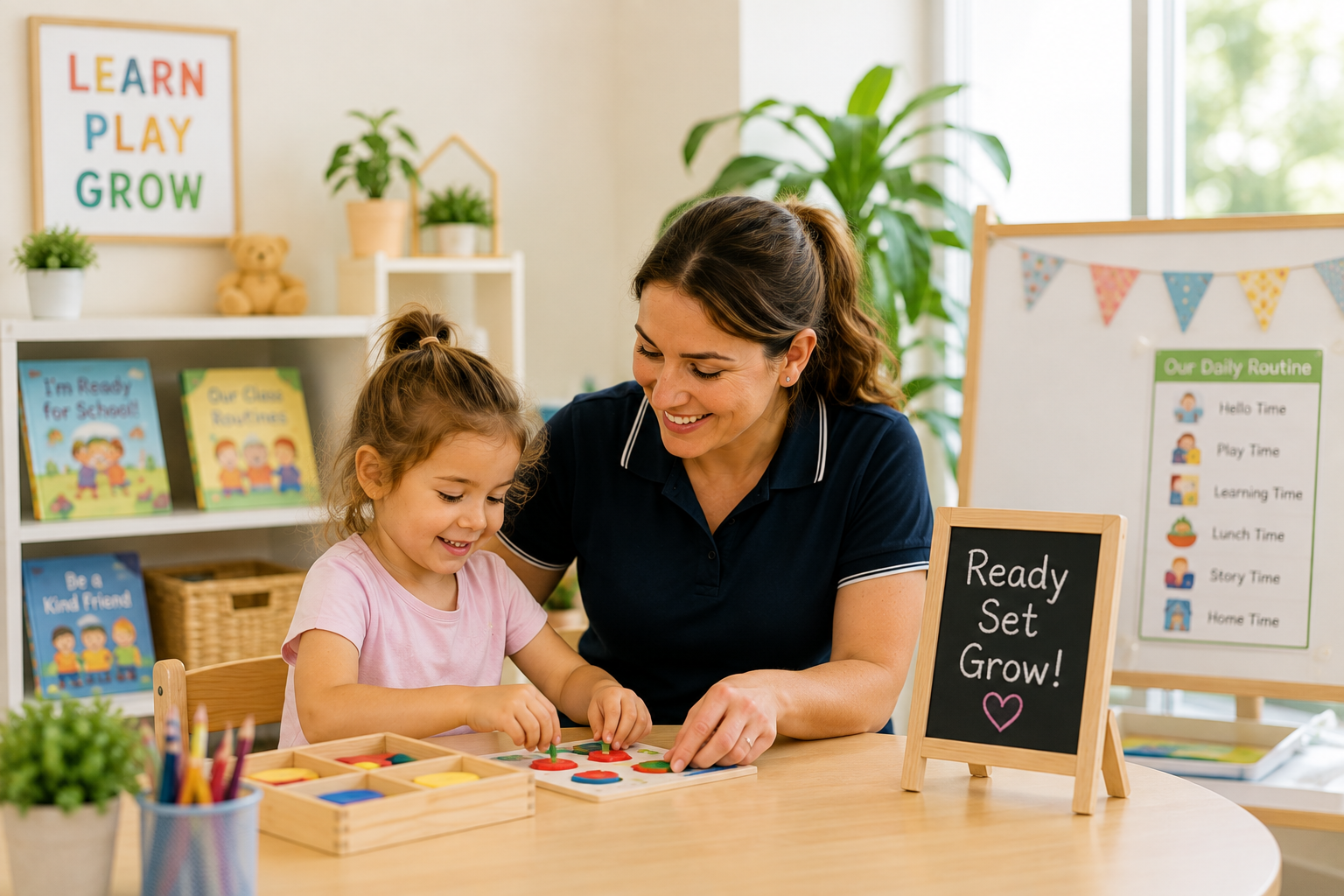

Starting school brings more than a new uniform, classroom, and teacher. A School Readiness Program for Preschool can help your child become familiar with the routines, friendships, and responsibilities that may become part of everyday school life.
What Does Your Child Need Before Starting School?
You may picture school readiness as knowing letters, numbers, or how to hold a pencil. While these skills have their place, your child also needs to feel comfortable with the everyday experiences that happen around learning.
Your child may need to put belongings away, listen during group activities, wait for a turn, follow simple directions, ask for help, and move from one activity to another.
These moments can seem small to you, but they can feel like big steps when your child is entering a new environment.
A supportive preschool experience gives your child regular opportunities to practise these skills through familiar routines, play and meaningful activities.
How Can Your Child Become Comfortable With New Routines?
Your child may already understand familiar routines at home. You might notice your child knowing when it is time to eat, wash hands, tidy toys or get ready to go outside.
Starting school introduces a different rhythm.
Your child may need to move between activities, listen to group instructions, manage personal belongings and participate in shared routines. Regular practice can help these experiences become easier to understand.
What Can Your Child Practise Each Day?
Your child may have opportunities to:
- Pack away materials after an activity
- Follow simple instructions
- Wait patiently for a turn
- Make choices about activities
- Care for personal belongings
- Move between indoor and outdoor experiences
- Ask for assistance when needed
- Take responsibility for small tasks
Your child can learn these skills without feeling like they are doing schoolwork. Everyday play, creative activities, and simple routines can give your child plenty of chances to learn while still having fun.
How Can Friendships Prepare Your Child for School?
Your child does not need to have everything figured out before starting school. Spending time with other children and learning how to share, communicate, and play together can help your child feel more comfortable in a group.
A shared block-building activity can teach your child to take turns. A group game can involve listening to others. A disagreement over a toy can give your child a chance to use words, listen, and consider another point of view.
You may see your child say, “Can I have a turn?” or learn to wait while another child finishes using something.
These ordinary interactions can help your child become more comfortable communicating and participating in a group.
What Can Your Child Learn From Small Challenges?
Your child will not get everything right on the first attempt, and that is an important part of learning.
A tower may fall. A puzzle may feel difficult. A painting may not turn out as expected. A friend may choose a different game.
Instead of solving every problem immediately, you can give your child time to think about what happened and try another approach.
At Lakeside Creative Minds, play-based learning can give your child opportunities to practise problem-solving, persistence and decision-making in situations that feel real and meaningful.
Why Does Independence Matter Before School?
Once school begins, your child cannot rely on an adult for every small decision.
Simple responsibilities can help your child practise doing things independently. Your child may learn to put belongings in the right place, choose materials for an activity, help tidy a space, or ask for assistance when something feels difficult.
Each small responsibility can give your child a stronger sense of capability.
How Can Hands-On Activities Support Your Child’s Readiness?
Your child can learn a great deal by doing rather than simply listening.
Cooking can involve following steps, counting ingredients, and talking about what happens next. Building can involve planning, sharing materials, and working out why a structure keeps falling.
At Lakeside Creative Minds, experiences such as STEAM, cooking, yoga, outdoor play and creative activities can give your child different ways to practise communication, cooperation, concentration, and problem-solving.
The learning happens naturally because your child is involved in something meaningful.
What Can Your Child Learn Through Everyday Conversations?
Your child learns more than new words during everyday conversations. Talking about an activity, explaining an idea, or telling you about a problem gives your child regular practice with expressing thoughts and listening to others.
During preschool, your child might talk about which activity to choose, explain how a block tower was built or tell you what happened during a game with a friend. These conversations can help your child organise ideas, describe feelings and communicate needs.
Your child can also begin to understand that communication works both ways. Listening to another child, responding to a question or explaining an idea can become part of the social skills your child uses throughout the day.
These simple conversations may look ordinary, but they give your child valuable practice in speaking, listening, and connecting with others skills that can become especially useful when a new school environment brings unfamiliar people and situations.
FAQs
1. What does school readiness involve?
School readiness can include communication, independence, social interaction, problem-solving, confidence, following routines, and participating in group experiences.
2. Does your child need to know how to read before starting school?
No. Your child can benefit from many other skills, including listening, communicating, making choices, managing simple responsibilities and participating in group activities.
3. How can routines help your child prepare for school?
Regular routines can help your child understand what happens next and practise moving between activities, following directions and taking responsibility for familiar tasks.
4. Can friendships help your child become more school-ready?
Yes. Friendships and group experiences can give your child opportunities to practise sharing, turn-taking, communication, cooperation and handling small disagreements.
5. How can play support school readiness?
Play gives your child opportunities to solve problems, make decisions, communicate ideas, cooperate with others and keep trying when something does not work.
6. How can you help your child become more independent?
Give your child manageable responsibilities and enough time to attempt tasks independently. Offer guidance when needed, while letting your child experience the satisfaction of completing something independently.
7. What if your child feels nervous about starting school?
You can acknowledge your child’s feelings and talk about what school may be like. Pretend play, simple conversations, and practicing familiar routines can make new experiences feel less unfamiliar.

