
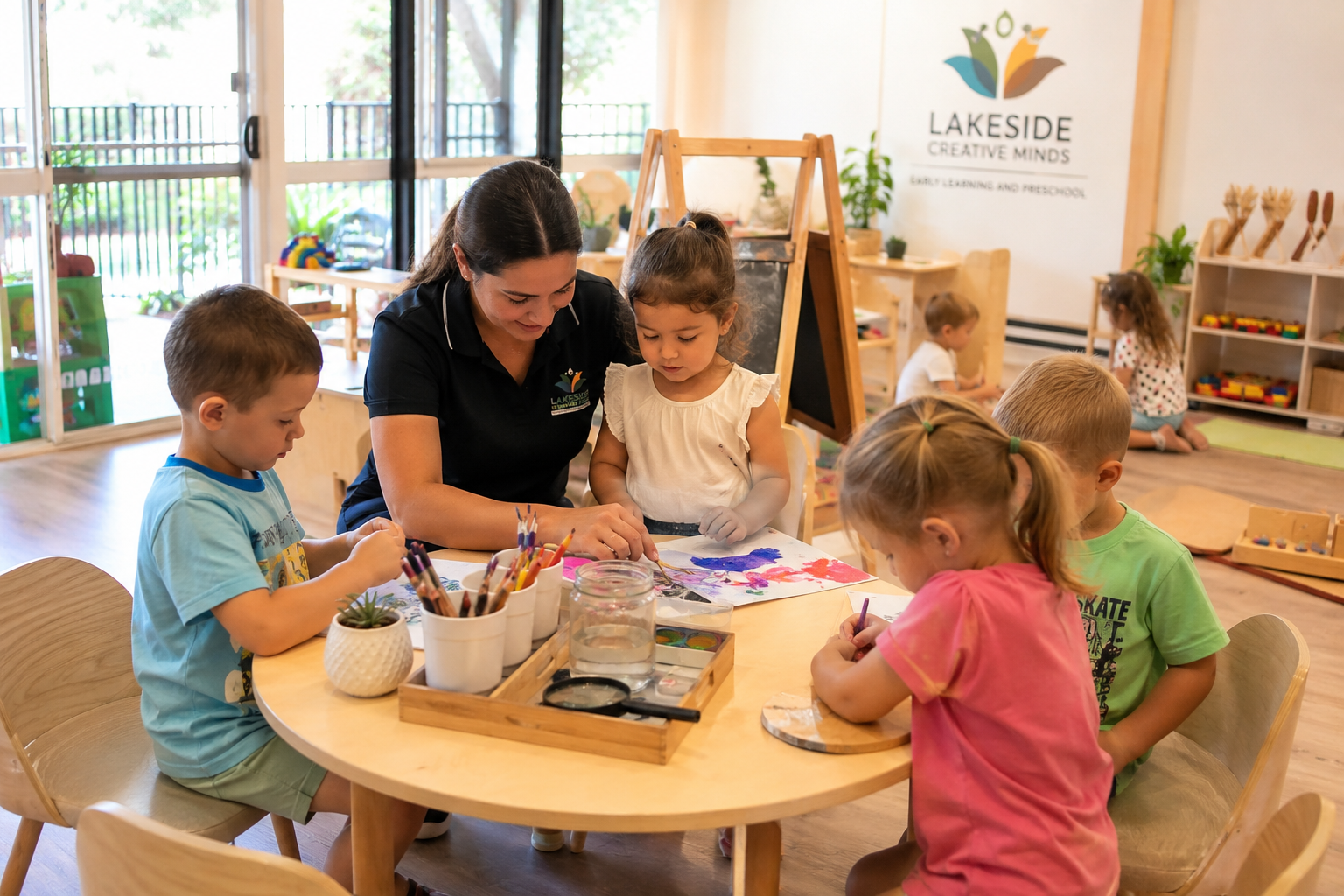

Your child can begin learning through ordinary moments long before the first school bell rings.
At an Early Learning Centre in Raymond Terrace, your child can experience learning through play, creativity, movement, relationships, and hands-on activities that make each day feel meaningful.
How Can You Make Learning Enjoyable for Your Child?
You do not need to turn every activity into a lesson for your child to learn.
Your child may learn while building a tower, mixing ingredients during cooking, creating artwork, or asking why something happens. When learning connects with your child’s interests, your child can become more willing to try, ask questions, and keep going when something does not work the first time.
At Lakeside Creative Minds Early Learning and Preschool, learning is woven into everyday experiences rather than treated as something separate from play.
How Can Play Encourage Your Child to Keep Learning?
Play gives your child room to make choices and follow ideas.
Your child might build a bridge with blocks, change the design when it falls, and try again. That simple experience can involve planning, problem-solving, coordination, and persistence.
You can give your child similar opportunities at home by allowing time for open-ended play instead of always showing your child exactly what to do.
How Can STEAM Activities Make Learning More Interesting?
Your child can encounter science, technology, engineering, arts, and mathematics through practical experiences.
These experiences can make early mathematical and problem-solving ideas feel connected to something your child can actually see and touch.
Why Do Creative Activities Matter?
Your child does not always need words to communicate an idea.
Painting, drawing, music, movement, and imaginative play can give your child different ways to express feelings and thoughts. You may notice your child becoming deeply focused while creating a picture or inventing a story with toys.
Creative experiences can also give your child freedom to make choices without worrying about producing a perfect result.
How Can Outdoor Play Add to Your Child’s Learning?
A large outdoor space can give your child more than somewhere to run.
Your child can notice changes in nature, practise physical skills, play cooperatively and use imagination while spending time outside. A simple activity such as collecting leaves can lead to conversations about colours, shapes, seasons and differences.
Outdoor time gives your child space to run, move, play with others and notice what is happening in the world around them. Simple experiences outside can support physical skills, curiosity and a growing connection with nature.
How Can Cooking Turn Everyday Tasks Into Learning?
Cooking can make early learning feel practical.
Your child can help measure ingredients, count objects, talk about different foods and follow a sequence of steps. You may also see your child become more willing to try unfamiliar foods when you involve your child in preparing them.
Cooking can give your child a simple and enjoyable way to practise counting, measuring, following steps and talking about different ingredients while taking part in a familiar everyday activity.
How Can Your Child Build Confidence Through Everyday Choices?
Your child can gain confidence when given genuine opportunities to make small decisions.
Choosing materials for an activity, deciding where to play or suggesting an idea for a group project can help your child feel that their thoughts matter.
Educators can support your child by listening to those ideas, asking questions and giving your child appropriate time to attempt tasks independently.
How Does the EYLF Support Joyful Learning?
The Early Years Learning Framework guides your child’s learning by focusing on important areas such as identity, community, wellbeing, learning and communication. This gives your child opportunities to build confidence, develop relationships and learn through everyday experiences.
This means your child can develop across different areas rather than focusing only on academic skills. Relationships, play, communication, independence and wellbeing can all become part of your child’s learning experience.
How Can a Welcoming Environment Affect Your Child?
Your child is more likely to participate when the environment feels comfortable and familiar.
Lakeside Creative Minds provides indoor learning areas alongside outdoor spaces, including areas for creativity, construction, books, numeracy, nature and puzzles.
You can also give your child time to settle into new surroundings. A calm goodbye, a familiar routine and regular communication with educators can help your child feel more comfortable.
How Can You Keep Learning Fun at Home?
You can continue your child’s learning without creating a classroom at home.
You can read a story together, count while setting the table, talk about what you see during a walk, or ask your child what might happen next during play. The goal is not to test your child but to show interest in what your child is thinking.
When your child feels that learning can be enjoyable, curiosity can become part of everyday life.
FAQs About Early Learning and Child Development
1. What can your child learn before starting school?
Your child can develop communication, social skills, independence, problem-solving, creativity, physical abilities, and early literacy and numeracy concepts through everyday experiences.
2. How does play help your child prepare for school?
Play can help your child practise sharing, listening, making choices, solving problems and staying with an activity, all of which can be useful when your child begins school.
3. What activities can make learning enjoyable for your child?
Your child can enjoy activities such as cooking, STEAM experiences, outdoor play, art, music, construction, puzzles, storytelling and imaginative play.
4. Why is outdoor play important for your child?
Outdoor play can give your child opportunities to develop physical coordination, social skills, confidence and awareness of nature while enjoying active movement.
5. How can you support your child’s learning at home?
You can read together, talk during everyday routines, provide time for play and encourage your child to ask questions and share ideas.

