
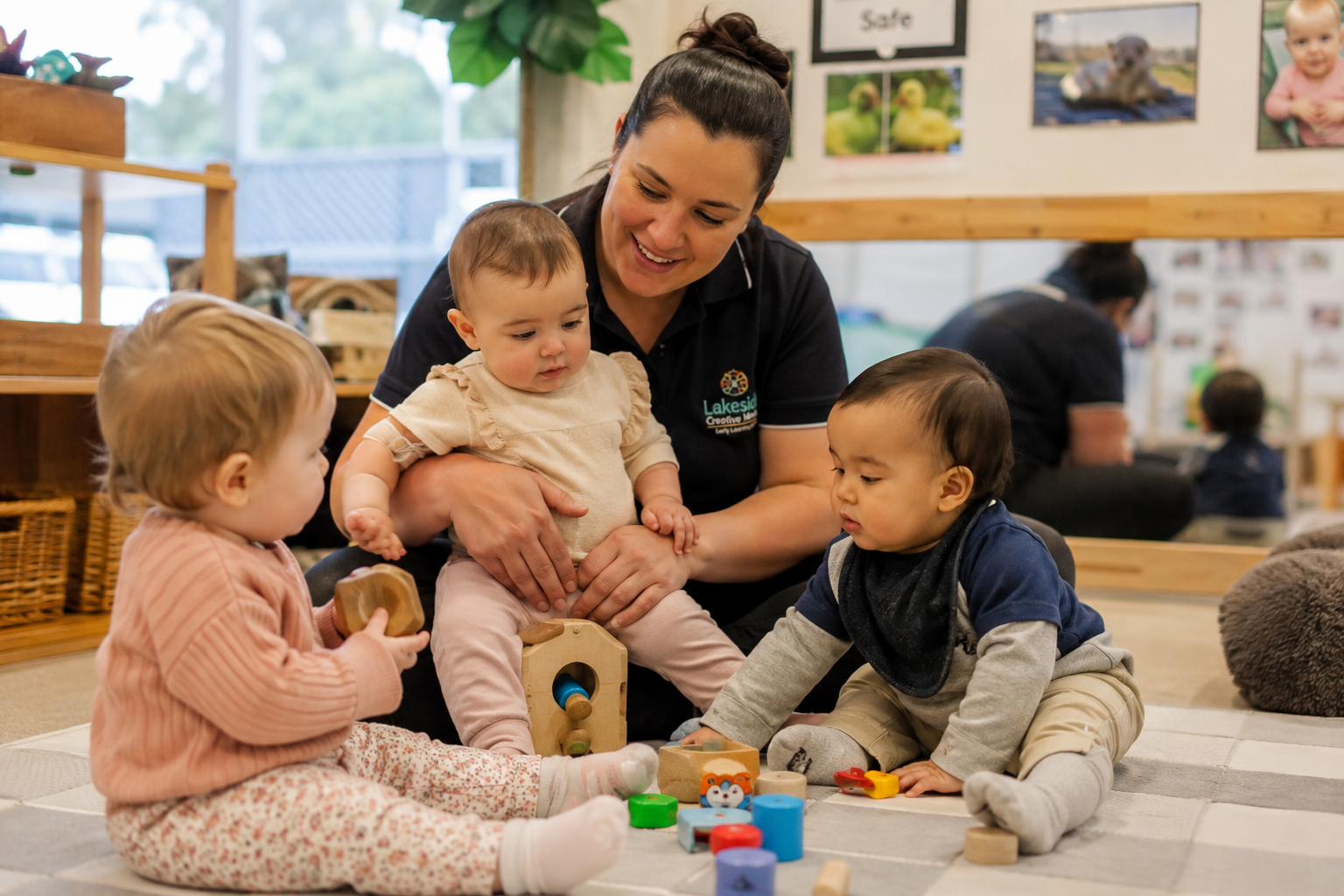

Your baby begins learning about relationships from the earliest months through sounds, facial expressions, movement, and everyday interactions. An Infant program gives your baby gentle opportunities to spend time around other children, notice what is happening nearby, respond to familiar faces, and build early social confidence while receiving caring, responsive support.
Social Experiences Begin Before Your Baby Can Talk
You may think of social development as something that starts when your baby begins talking or playing with another child. In reality, your baby starts building social awareness much earlier.
When your baby watches another child crawl across the room, turns towards a new sound, smiles at a familiar face, or reaches towards a toy that another child is using, your baby is already responding to the people around them.
These small moments matter.
Your baby learns to notice movement, listen to different sounds, recognise familiar voices, and respond to facial expressions. With regular opportunities to be around other children, your baby gradually becomes more comfortable sharing a learning space with people outside your immediate family.
How Can Your Baby Learn From Being Around Other Children?
Your baby does not need to play cooperatively to benefit from being around other children.
You may see your baby watching another child shake a toy, clap their hands, crawl towards a colourful object, or respond to a song. Your baby may then copy a movement, make a sound, smile, or reach for something nearby.
This kind of learning happens naturally.
Your baby can begin to understand that other people have their own actions and responses. These experiences support early attention, communication, imitation, and social awareness without putting pressure on your baby to interact before they feel ready.
Familiar Educators Help Your Baby Feel Secure
Your baby needs to feel safe before feeling comfortable around new people.
You may notice that your baby becomes familiar with an educator’s voice, facial expression, or way of comforting them. That familiarity can help your baby settle into the day and feel more comfortable participating in experiences around other children.
When your baby knows that a trusted educator is nearby, your baby has a secure base from which to watch, listen, move, and interact.
Learning to Share Space Comes First
Your baby will not understand sharing in the same way as an older child, and that is perfectly normal.
Instead, your baby can begin by learning what it feels like to be part of a group.
Imagine your baby sitting on a soft mat while another child plays nearby. Your baby may watch the other child move, listen to their sounds, or become interested in the same toy. Your baby is learning to share space, attention, and experiences.
Over time, these everyday moments can help your baby become familiar with being alongside others.
Sensory Experiences Can Encourage Social Interaction
Sensory play gives your baby another natural way to connect with the environment and the people around them.
Your baby may experience different textures, sounds, colours, movements, and age-appropriate materials. While your baby interacts with these experiences, your baby can also notice what another child is doing nearby.
For example, your baby might watch another child touch a textured object and then reach towards it. An educator can respond to your baby’s interest with simple words, gestures, and encouragement.
You can see how one simple sensory experience can involve attention, communication, movement, curiosity, and social awareness at the same time.
Songs and Simple Group Moments Build Connection
Your baby can enjoy social experiences without needing to sit through a formal lesson.
Songs, gentle music, movement, facial expressions, and repeated sounds can encourage your baby to watch and listen. Your baby may smile when a familiar song begins, move their hands, make sounds, or look towards another child.
Repeated experiences can help your baby become familiar with group moments.
You can also continue this type of learning at home by singing familiar songs, copying your baby’s sounds, and responding to facial expressions. Your response shows your baby that communication can happen through sounds, gestures, movement, and eye contact.
Outdoor Experiences Give Your Baby More Opportunities to Connect
A change of environment can create new social experiences for your baby.
Outdoor time can give your baby opportunities to watch movement, listen to different sounds, feel natural textures, and observe other children playing nearby. Your baby may become interested in a moving ball, a leaf, a sound, or another child walking past.
At Lakeside Creative Minds Early Learning and Preschool, your baby can experience safe outdoor environments as part of the daily learning routine.
These experiences can support physical development while giving your baby more opportunities to observe and respond to the world around them.
Your Baby’s Individual Pace Still Comes First
You cannot expect every baby to respond to other children in the same way.
Your baby may happily watch from a comfortable distance for several days before showing interest in another child. Your baby may prefer interacting with an educator first. Your baby may also become more socially interested as familiarity grows.
That is why your baby’s individual pace matters.
Responsive care allows your baby to communicate through sounds, movements, expressions, and behaviour. Your baby’s cues can guide the experience rather than forcing participation.
How Does the EYLF Support Early Social Learning?
The Early Years Learning Framework provides a foundation for your baby’s experiences at Lakeside Creative Minds Early Learning and Preschool.
Through everyday care, play, communication, and relationships, your baby can begin developing a sense of identity, wellbeing, belonging, and connection.
Your baby’s learning does not have to look like a traditional classroom activity. A cuddle with a trusted educator, a shared song, watching another child play, or responding to a familiar voice can all become meaningful learning experiences.
This approach allows your baby to learn naturally through relationships and everyday routines.
How Can You Support Social Development at Home?
You can continue building your baby’s early social experiences through simple activities at home.
You can give your baby time to watch other children at a park, attend family gatherings, sing together, read picture books, and respond to your baby’s sounds and expressions.
You can also put your baby’s feelings into simple words. If your baby watches another child laugh, you might say, “You heard that child laughing.” If your baby reaches towards another child, you can calmly acknowledge the interest.
These small conversations help your baby connect people, sounds, emotions, and experiences.
A Caring Environment Makes Social Experiences Feel Natural
Your baby’s first experiences with other children do not need to involve complicated activities. A smile, a shared song, a curious glance, a sound, or watching another child play can all become valuable moments.
At Lakeside Creative Minds Early Learning and Preschool, your baby can experience these moments within a calm environment supported by consistent educators, responsive care, individual routines, sensory experiences, and EYLF-aligned learning.
When your baby feels safe and understood, your baby has more freedom to watch, respond, communicate, and gradually become comfortable around others. Those small social moments can become the early building blocks for confident relationships as your baby continues growing.
Frequently Asked Questions
1. Can your baby develop social skills before learning to talk?
Yes. Your baby can begin developing social awareness through eye contact, facial expressions, sounds, gestures, imitation, and watching other children.
2. Does your baby need to play directly with other children?
No. Your baby can benefit simply from being around other children. Watching, listening, and responding to what happens nearby are important early social experiences.
3. How can educators support your baby around other children?
Your baby’s educators can stay close, respond to your baby’s cues, provide reassurance, model simple interactions, and give your baby time to become comfortable.
4. How does sensory play support my baby’s social development?
Sensory experiences can encourage your baby to watch, listen, respond, and interact while noticing what other children are doing. Your baby can build social awareness naturally during these experiences.
5. What if your baby is not interested in other children?
Your baby does not need to interact immediately. Your baby may prefer to watch from a comfortable distance or stay close to a familiar educator. With time and repeated experiences, your baby can become more comfortable.
6. How can you support your baby’s social learning at home?
You can sing songs, read together, respond to sounds and facial expressions, visit family-friendly places, and give your baby relaxed opportunities to observe other children.
7. Why are familiar educators important for my baby?
Familiar educators can help your baby feel secure and understood. When your baby knows who is nearby, your baby may feel more comfortable taking part in new experiences and observing other children.
Your baby’s social journey begins with very small moments. A glance across the room, a smile during a song, or curiosity about another child can be the beginning of learning how relationships work. With responsive care, familiar educators, and plenty of gentle opportunities to be around others, your baby can build these early social experiences at a pace that feels right for them.

