

Your child does not approach learning in the same way as another child. One child may spend ages building towers, while another may want to paint, ask questions about insects, look through books, or help with cooking. A preschool in Raymond Terrace can give your child opportunities to follow those interests while developing important skills through play, relationships, creativity, and everyday experiences.
At Lakeside Creative Minds Early Learning and Preschool, learning is guided by the Early Years Learning Framework (EYLF), with tailored programs designed around each child’s individual journey. This approach gives your child room to participate in experiences that connect with their interests, abilities, and developing ideas.
Why Do Your Child’s Interests Matter in Preschool?
Your child’s interests can give you useful clues about how they prefer to engage with the world.
You may notice your child repeatedly choosing construction toys, asking questions about animals, creating pretend stories, or spending time outdoors. These preferences can become starting points for meaningful learning.
When an activity connects with something your child already enjoys, you may notice greater concentration and willingness to participate. Your child may also be more likely to ask questions, communicate ideas, and keep trying when something becomes challenging.
This does not mean every activity needs to follow your child’s favourite subject. Instead, familiar interests can provide a practical starting point for introducing new ideas.
How Can Educators Turn Interests Into Learning Opportunities?
Your Child’s Curiosity Can Lead to New Experiences
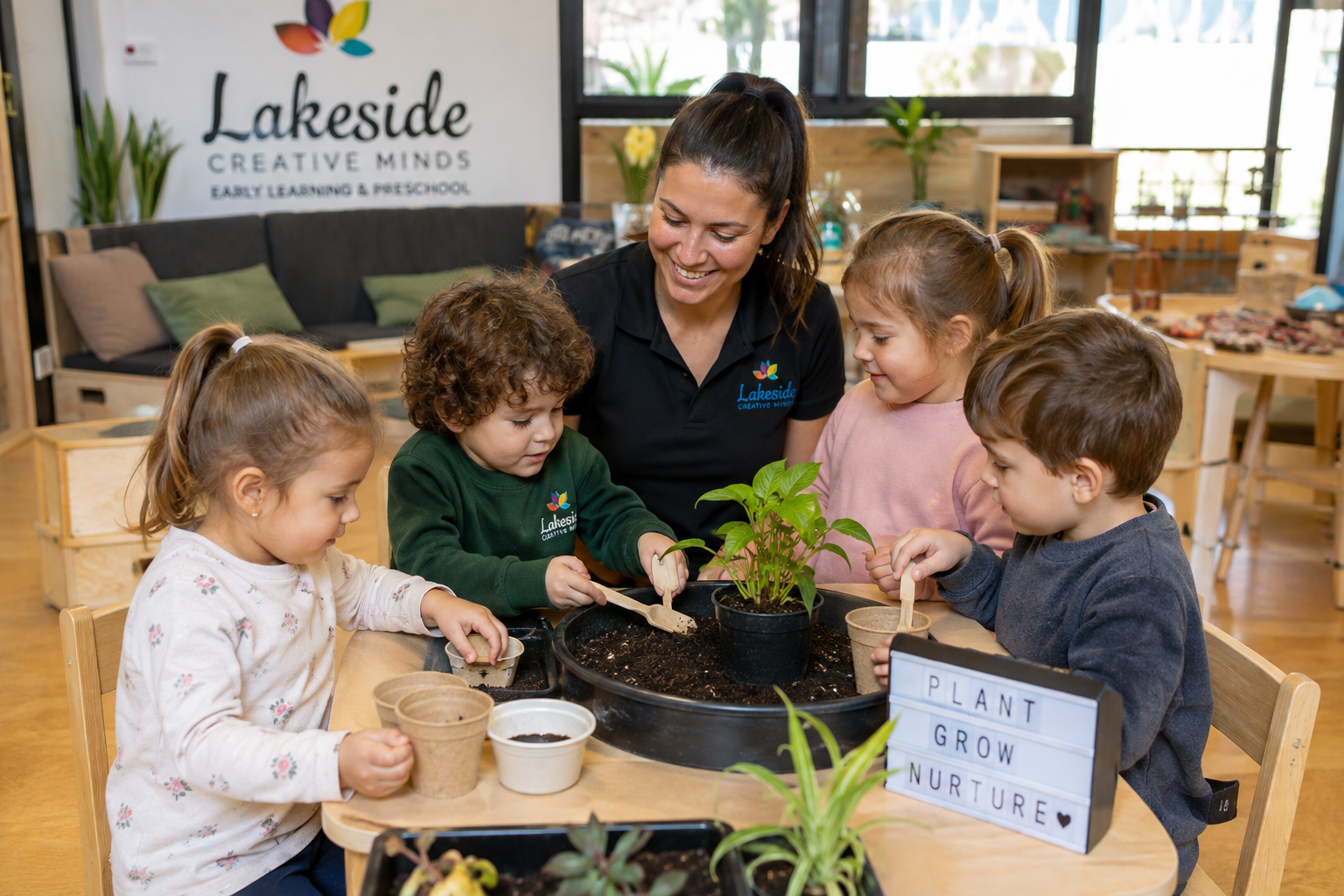
Imagine your child becomes fascinated by plants.
That interest could lead to conversations about what plants need to grow, counting leaves, drawing pictures, planting seeds, reading books, or caring for a garden. One simple interest can connect with language, early mathematics, science, creativity, responsibility, and social learning.
This means your child’s interests can become part of a broader learning experience rather than remaining a short-lived activity.
How Can Construction Play Support Your Child’s Development?
Your child may naturally gravitate towards blocks, building materials, puzzles, or construction activities.
When you give your child time to build, you give them opportunities to think about size, shape, balance, position, and sequence. Your child may build a bridge, knock it down, change the design, and try again.
That process can encourage problem-solving and persistence.
Lakeside Creative Minds includes a dedicated construction area among its learning spaces, giving your child opportunities to work with materials and develop ideas through hands-on experiences.
What If Your Child Loves Art and Creative Activities?
Your child may communicate ideas more comfortably through drawing, painting, music, dramatic play, or creating something with their hands.
Creative experiences can give your child freedom to make decisions without having one “correct” result.
You may see your child choose colours, create characters, invent a story, or turn a simple drawing into an imaginative scene. While your child is creating, they can also practise coordination, language, concentration, decision-making, and self-expression.
Lakeside Creative Minds includes creativity and art among its learning areas, giving your child opportunities to communicate and create in different ways.
How Can Outdoor Interests Become Learning?
Some children seem happiest when they can move, run, investigate, and spend time outside.
Your child might become interested in insects, leaves, water, weather, rocks, or gardening. These observations can lead to conversations and hands-on experiences that connect your child with the natural environment.
Outdoor play can also give your child space to develop physical coordination, imaginative play, social skills, and confidence.
Lakeside Creative Minds provides a large outdoor area where your child can participate in active and creative experiences. Nature and surroundings are also included among the centre’s learning areas.
Can STEAM Learning Follow Your Child’s Interests?
Your child’s questions can sometimes become the beginning of a much bigger learning experience.
If your child asks why something floats, how a structure stays upright, or what happens when two materials are combined, you can encourage further thinking through age-appropriate experimentation.
STEAM learning can connect science, technology, engineering, arts, and mathematics with practical activities. Your child can test ideas, make changes, compare results, and work alongside others.
Lakeside Creative Minds includes STEAM education within its programs, with creativity, problem-solving, collaboration, engagement, and motivation identified as important areas.
How Can Cooking Turn an Interest Into Practical Learning?
Your child may become interested simply because they see food being prepared.
Cooking can provide opportunities to introduce early mathematical concepts through measuring, counting, sorting, and comparing. Your child can also practise language by naming ingredients, describing steps, and talking about tastes and textures.
Lakeside Creative Minds offers cooking classes and connects them with basic mathematics, language skills, and healthy eating habits.
For your child, learning can therefore happen through an activity that feels familiar and enjoyable.
How Can Interests Help Your Child Build Confidence?
Your child can feel a sense of achievement when they have an opportunity to work with something they genuinely enjoy.
Suppose your child rarely speaks during group activities but becomes very talkative when discussing dinosaurs. An educator who notices that interest may use dinosaurs as a starting point for storytelling, drawing, counting, books, or group conversations.
Your child then has a familiar subject that can make participation feel more comfortable.
Over time, that experience can encourage your child to communicate about other subjects too.
How Can You Share Your Child’s Interests With Educators?
You know your child in ways that an educator cannot learn immediately.
You may know that your child talks constantly about trains at home, enjoys helping in the kitchen, collects leaves during walks, or spends hours creating imaginary stories.
Sharing these observations with educators can give them useful information when planning experiences.
Strong communication between you and your child’s educators can also help create greater consistency between home and preschool. Lakeside Creative Minds highlights child-staff-family relationships as an important part of its approach.
What Should You Look For in a Preschool Program?
When you visit a centre, look at whether your child has genuine opportunities to participate rather than simply being expected to follow a fixed routine.
You can ask:
- How are children’s interests included in learning?
- How do educators observe children during play?
- How are learning experiences planned?
- Are there opportunities for outdoor and hands-on learning?
- How can you share information about your child’s interests?
- How does the centre support different ways of learning?
At Lakeside Creative Minds, tailored learning programs, STEAM education, outdoor spaces, creative areas, cooking, sustainability, yoga, and school readiness form part of the centre’s range of experiences.
How Can Your Child’s Interests Shape Their Everyday Learning?
Your child does not need to arrive with a fixed list of skills or interests. You can give your child room to show you what catches their attention, what makes them ask questions, and what keeps them coming back for another try.
At Lakeside Creative Minds Early Learning and Preschool, those interests can become useful starting points for play, creativity, STEAM experiences, outdoor learning, cooking, sustainability, communication, and developing independence.
When you give your child space to be curious, and educators have the opportunity to build on that curiosity, an ordinary interest can become the beginning of something much bigger.
Frequently Asked Questions
1. Why are your child’s interests important in preschool?
Your child’s interests can provide useful starting points for learning because familiar subjects can encourage curiosity, participation, communication, and concentration.
2. Can educators change activities based on your child’s interests?
Educators can use observations of your child’s play and interests when planning suitable experiences, while still introducing new ideas and learning opportunities.
3. Does following your child’s interests mean your child only does favourite activities?
No. Your child’s interests can provide a starting point for introducing new skills, ideas, materials, and experiences.
4. How can you tell educators about your child’s interests?
You can share what your child talks about at home, the activities they repeatedly choose, questions they ask, and hobbies or experiences they particularly enjoy.
5. Can interests help your child become more confident?
Yes. Familiar interests can give your child a comfortable starting point for communication and participation, which may encourage them to become involved in less familiar experiences over time.
6. How does the EYLF connect with your child’s interests?
The EYLF provides a framework for planning learning around areas such as identity, community, wellbeing, learning, and communication. Lakeside Creative Minds uses the EYLF as the foundation for its learning approach.
7. What if your child’s interests change frequently?
That is completely normal. Your child can move from one interest to another as new experiences, questions, and ideas develop. Observing those changes can help educators respond to what currently captures your child’s attention.

