
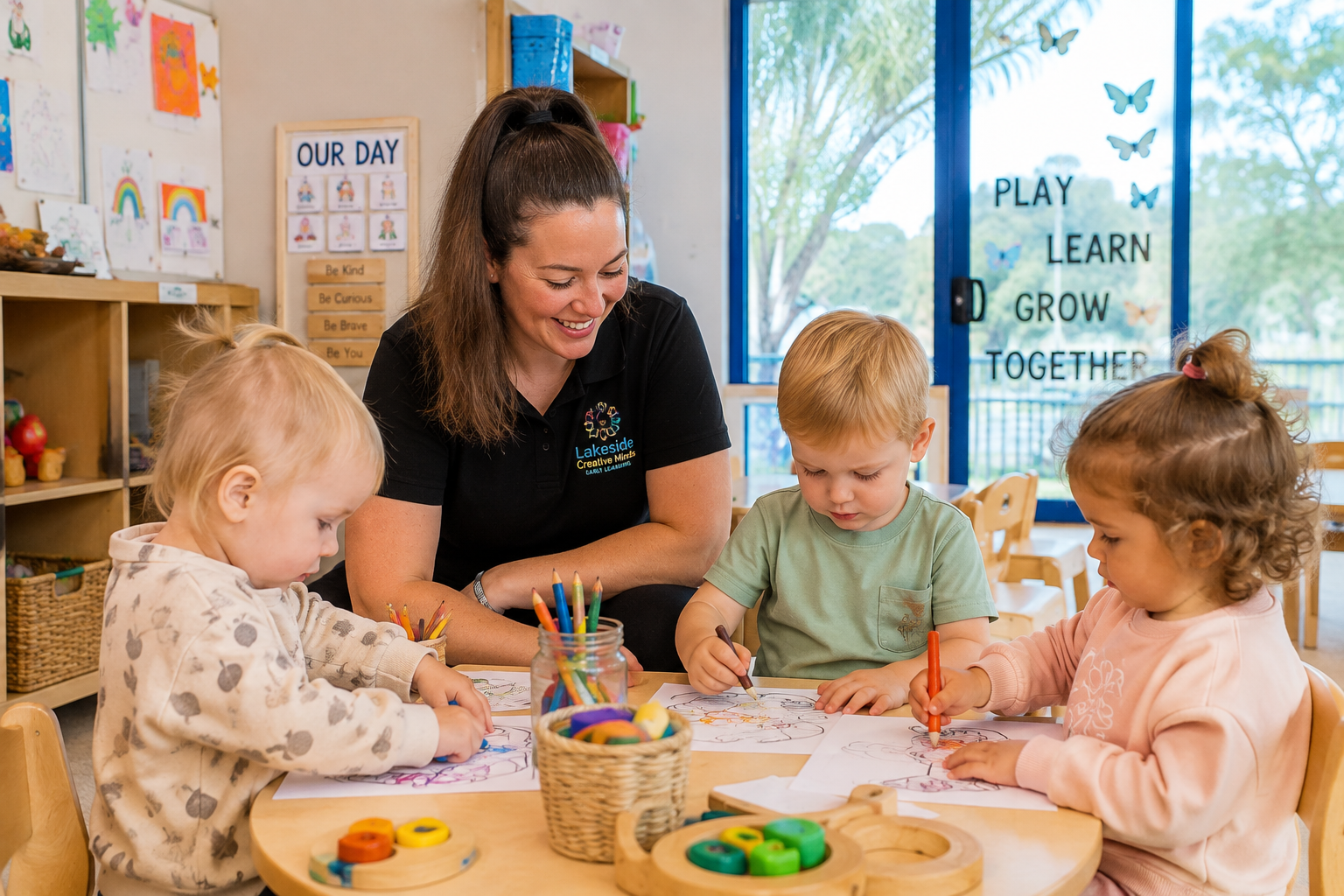

Your toddler learns something new almost every day, often through the smallest moments: a new word, a different texture, or a first attempt at doing something independently. Toddler daycare in Raymond Terrace can provide a setting where those moments become part of a calm, playful day without pressuring your child to achieve too much too soon.
At Lakeside Creative Minds Early Learning and Preschool, you can give your toddler time to play, communicate, make connections, and build confidence while qualified educators respond to individual interests and developmental needs. The focus stays on meaningful early learning rather than rushing towards the next stage.
What Does Curiosity Look Like at Toddler Age?
At two or three years old, curiosity rarely looks like sitting down for a formal lesson. Your toddler may become fascinated by pouring water, asking the same question repeatedly, joining a song, sorting objects, or watching what happens when two materials meet.
These everyday moments can become valuable learning opportunities.
A toddler who spends several minutes trying to fit different objects into a container is already working on problem-solving. When you hear your child explaining what happened, you are also seeing communication develop. When your child waits for another toddler to have a turn, social learning is happening too.
That is why play has such an important place in early childhood.
How Can Play Encourage Learning Without Pressure?
Letting Your Toddler Follow Genuine Interests
You do not need every activity to have a complicated learning objective. Your toddler can learn a great deal when you have space to follow genuine interests.
At Lakeside Creative Minds, experiences can include art, music, stories, outdoor play, and hands-on activities. These experiences give you opportunities to see your child choose, experiment, communicate, and try again.
For example, your toddler might spend time with paint and become interested in mixing colours. Another day, your child might become absorbed in a story or outdoor activity. Both experiences can support learning without turning play into a test.
Giving Independence Room to Grow
You may notice that your toddler wants to do more things alone—holding a cup, choosing an activity, putting belongings away, or attempting a simple task without help.
That independence deserves patience.
A supportive toddler program can give your child small opportunities to make choices and practise everyday skills. Your child does not have to get everything right immediately. Trying, making mistakes, and trying again are valuable parts of growing confidence.
Why Do Predictable Routines Matter?
Curiosity works best when your toddler feels comfortable with the surroundings.
A familiar daily rhythm can help your child understand what comes next. Meals, rest, play, stories, outdoor experiences, and interactions with educators can create a reassuring pattern while still leaving room for spontaneous learning.
At Lakeside Creative Minds, predictable routines are paired with responsiveness to your toddler’s individual needs. This balance can help your child feel settled while still having opportunities to make choices and follow interests.
You can think of it as having a dependable framework rather than a rigid timetable.
How Do Small Groups Support Your Toddler?
Your toddler is still learning how to communicate feelings, share space, wait for a turn, and interact with other children.
You may see this in simple moments: your child asking for help, showing an educator a drawing, joining another child during play, or becoming more comfortable speaking in a group.
These interactions can build communication and social confidence naturally.
What Role Do Educators Play in Curiosity?
Watching, Listening and Responding
Qualified educators do more than organise activities. They watch how your toddler approaches experiences and respond to what your child shows them.
If your toddler becomes interested in animals, for example, an educator can introduce stories, sounds, movement, drawing, or conversation around that interest. If your child prefers building, an educator can provide opportunities to stack, connect, balance, and solve simple problems.
Your toddler gets to learn from what already feels interesting.
Keeping Childhood at the Centre
You want your toddler to develop useful skills, but you also want your child to enjoy being a toddler.
That means learning can happen through laughter, messy art, movement, friendships, outdoor play, songs, stories, and ordinary routines. Your child can build early literacy, numeracy, communication, social, emotional, and physical skills without spending the day feeling like school has already begun.
How Does the EYLF Guide Early Learning?
The Early Years Learning Framework provides a foundation for meaningful early childhood learning. At Lakeside Creative Minds, the program aligns with the EYLF and connects learning with everyday experiences.
You can see this approach through opportunities for communication, relationships, wellbeing, confidence, problem-solving, creativity, and participation.
Rather than expecting every toddler to reach milestones at exactly the same time, you can give your child opportunities to develop at an individual pace while educators provide appropriate support.
What Can You Expect From Lakeside Creative Minds?
When you choose Lakeside Creative Minds Early Learning and Preschool, you can expect a toddler-focused environment built around care, play, interaction, and intentional learning.
You can also benefit from:
- Small group sizes and individual attention
- Qualified Diploma and Certificate III educators
- EYLF-aligned learning experiences
- Purpose-built spaces for young children
- Arts, music, stories, and outdoor play
- Opportunities for communication and problem-solving
- Consistent daily routines
- Regular communication with your family
You can also stay connected with your child’s day through updates about activities, meals, rest, milestones, and conversations with educators.
FAQs About Toddler Early Learning
1. What age is a toddler program designed for?
You can generally consider a toddler program for children around two to three years old. Individual readiness and developmental needs can vary, so you can discuss your child’s circumstances with the centre.
2. How does play support toddler learning?
Your toddler can develop communication, problem-solving, social skills, coordination, creativity, and independence through ordinary play experiences.
3. Will my toddler have a structured daily routine?
Yes. Your child can experience predictable routines around daily care and learning while still having flexibility to follow interests and respond to changing needs.
4. Can my toddler develop independence?
Yes. Your toddler can practise age-appropriate choices and everyday tasks with supportive guidance, allowing confidence to grow gradually.
5. How can you stay informed about your toddler’s day?
You can receive communication about your child’s activities, meals, rest, milestones, and daily experiences, while educators remain available for meaningful conversations.
6. Does the program prepare your toddler for preschool?
Your child can develop early communication, social, emotional, problem-solving, and independence skills that provide useful foundations for the next stage of learning.
Your toddler does not need to race towards the future to be ready for it. When you give your child time to play, ask questions, make choices, build relationships, and try again, everyday experiences can become meaningful steps in growing confidence, and childhood still gets to feel like childhood. At Lakeside Creative Minds Early Learning and Preschool, you can give your child the space to grow at their own pace while enjoying meaningful learning experiences. Here, every little moment can help your child build confidence for the next stage.

