
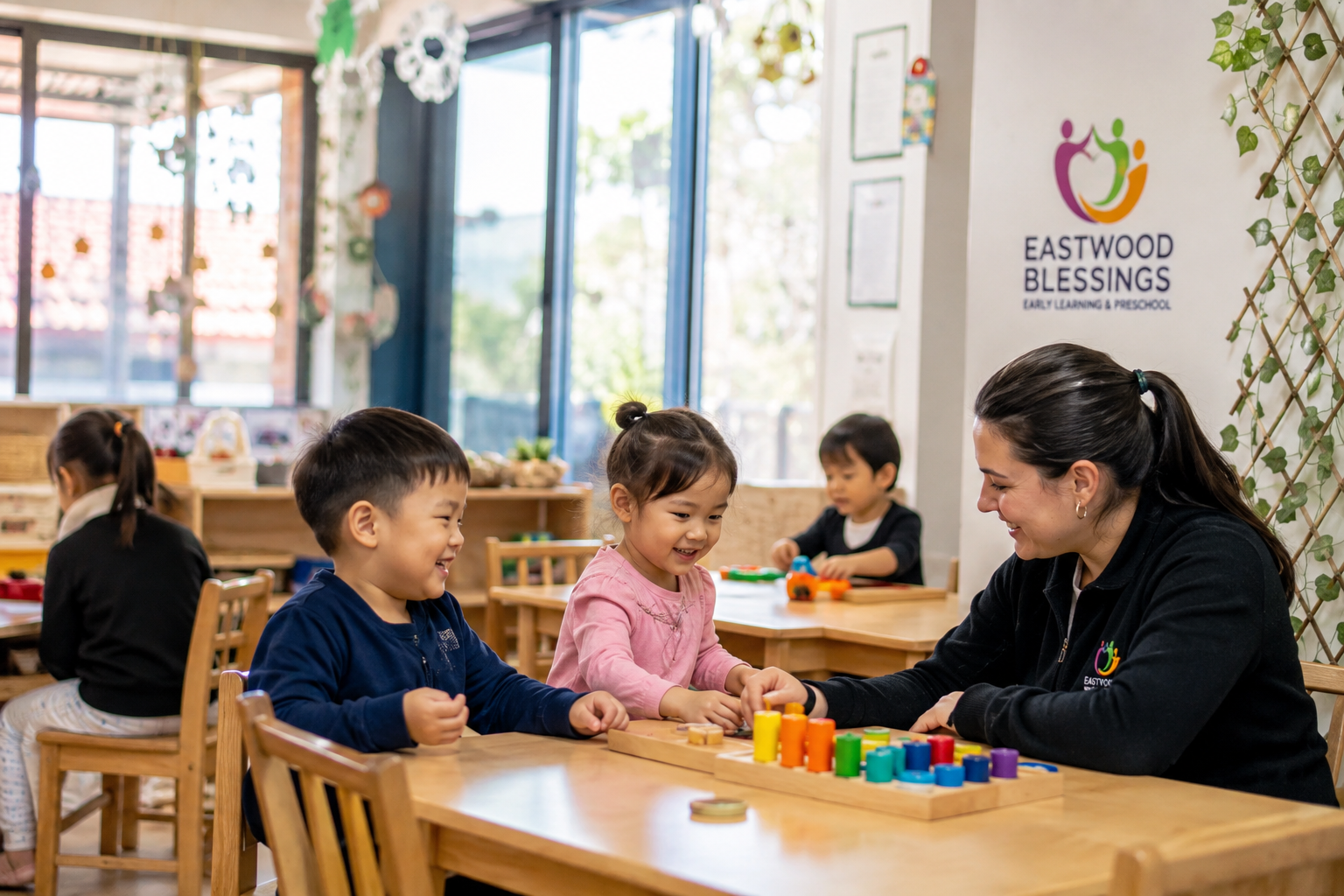

Your child can reach important developmental milestones through small, everyday experiences that encourage movement, communication, curiosity, and independence. At the Best Preschool in Raymond Terrace, your child can take part in play, conversations, creative activities, and practical experiences that match their stage of development. These experiences give your child time to practise new skills, make choices, solve simple problems, and interact with others. With patient guidance and meaningful routines, your child can build confidence while progressing at a pace that feels right for them
How Does Everyday Learning Support Your Child’s Development?
Your child learns through everyday moments, not just planned activities. Simple experiences such as talking, playing, creating, moving, and helping with routines give your child chances to practise new skills. Over time, these small experiences can help your child become more confident, independent, social, and ready to take on new challenges.
Your child can learn and grow through simple moments that happen throughout the day. Playing, talking, creating, moving, and joining everyday routines can help your child naturally practise new skills.
Each experience gives your child a chance to try something new, make choices, solve small problems, and interact with others. Over time, these moments can help your child become more confident and independent.
Learning Through Everyday Play
You do not need worksheets or long lessons to help your child learn. Play can provide some of the richest learning experiences.
For example, when your child takes part in a pretend shop game, you may simply see them playing. In that moment, your child can practise speaking, counting, taking turns, making choices, and using their imagination. Asking what they want to buy or how much something costs can turn a simple game into a meaningful learning experience.
Supporting Language and Communication
Your child’s communication skills grow through regular interaction.
You may notice educators asking questions during play rather than simply giving instructions. A cooking activity, for example, can encourage your child to name ingredients, describe textures, follow steps, and talk about what happens next.
At Lakeside Creative Minds, cooking activities are part of the learning experience and can support early mathematical thinking and language development.
How Everyday Conversations Help Your Child Grow?
You can support this progress by giving your child time to speak. Instead of rushing to answer, pause and listen.
If your child says, “I made a big house,” you can respond with, “You made a big house. Who lives inside?” A simple conversation can become an opportunity for your child to use new words, explain ideas, and build confidence.
Building Social and Emotional Skills
Reaching a milestone is not always about learning a new academic skill.
Your child may need to learn how to wait, share, cope when something does not go their way, or ask another child to join a game. These experiences can feel challenging, but they are important parts of growing independence.
A supportive preschool environment gives your child regular opportunities to practise these skills with other children and familiar educators.
Your child can build confidence and independence by investigating new ideas, solving simple problems, and trying things without giving up. These everyday experiences can help your child develop resilience while learning to trust their own abilities.
Developing Physical Skills Through Movement
Running, climbing, balancing, drawing, and using small objects all contribute to physical development.
A spacious outdoor environment can give your child room to practise large movements, while indoor activities such as puzzles, drawing and construction can support hand and finger control.
A spacious outdoor area and thoughtfully planned learning spaces give your child room to move, create, play, and take part in hands-on activities. These spaces allow your child to practise physical skills, make choices, and enjoy learning through active experiences.
Yoga and Movement Activities
Movement gives your child a natural way to practise balance, coordination, and body control. Activities such as yoga, stretching, and simple movement games can help your child become more aware of how their body moves.
These activities also give your child opportunities to practise focus and calmness while enjoying active play. With regular movement, your child can gradually build confidence in using their body and trying new physical challenges.
Encouraging Thinking and Problem-Solving
Your child develops stronger thinking skills when they have time to figure things out on their own. Instead of answering straight away, you can give your child space to think, make a choice, and try a different way.
Hands-on activities can make this learning feel natural. Your child might sort objects, create a simple structure, test what happens when something moves, or work with another child to solve a small challenge.
As your child tries, changes, and tries again, they learn that problems can have different solutions. These experiences can build curiosity, concentration, creativity, and confidence while your child enjoys the learning process.
Supporting Individual Development
You should not expect every child to reach every milestone at the same time.
One child may confidently speak in a group while another may communicate more comfortably through gestures, drawing, or one-to-one conversations. Another child may show strong physical skills while still developing social confidence.
Every child develops differently, so learning can be shaped around your child’s interests, abilities, and individual pace.
This means your child can receive opportunities that match their interests, abilities, and current stage of development.
Preparing Your Child for School
School readiness involves much more than recognising letters and numbers.
Your child also benefits from learning how to listen, follow routines, communicate needs, manage belongings, participate in group experiences and become more independent.
Confidence and independence are important parts of getting ready for school. An EYLF-based approach also gives your child opportunities to build a strong sense of identity, connect with others, develop wellbeing, enjoy learning, and communicate their ideas.
When you give your child opportunities to practise these skills before school, everyday routines can feel more familiar.
Why the Learning Environment Matters?
Your child learns from the people around them and from the spaces they use each day. At Lakeside Creative Minds Early Learning and Preschool, thoughtfully planned spaces give your child different ways to play, communicate, move, create, and solve problems.
A quiet reading space can encourage language and concentration, while outdoor play can support balance, coordination, and confidence. Creative and hands-on areas can also give your child opportunities to make choices and practise new skills.
Learning does not need to feel like a formal lesson. When your child enjoys what they are doing, they can naturally ask questions, try new ideas, and keep practising as their skills grow.
FAQs
1. What are developmental milestones?
Developmental milestones are skills your child gradually develops in areas such as communication, movement, thinking, social interaction, emotional regulation and independence.
2. Does preschool support developmental milestones?
Yes. A well-planned preschool program can give your child regular opportunities to practise age-appropriate skills through play, routines, relationships and guided learning experiences.
3. Does every child reach milestones at the same age?
No. Children develop at different rates. Your child may reach one skill earlier and another later, so individual progress matters.
4. How does play support development?
Play can help your child practise communication, coordination, problem-solving, creativity, cooperation and decision-making without making learning feel like formal schoolwork.
5. How does Lakeside Creative Minds support child development?
Lakeside Creative Minds uses an EYLF-based program with play-based learning, STEAM activities, cooking, yoga, outdoor experiences and tailored learning opportunities to support different areas of your child’s development.
6. Can preschool help with school readiness?
Yes. Preschool can help your child practise independence, communication, social interaction, routines, confidence and participation in group learning, all of which can support the move to school.

