
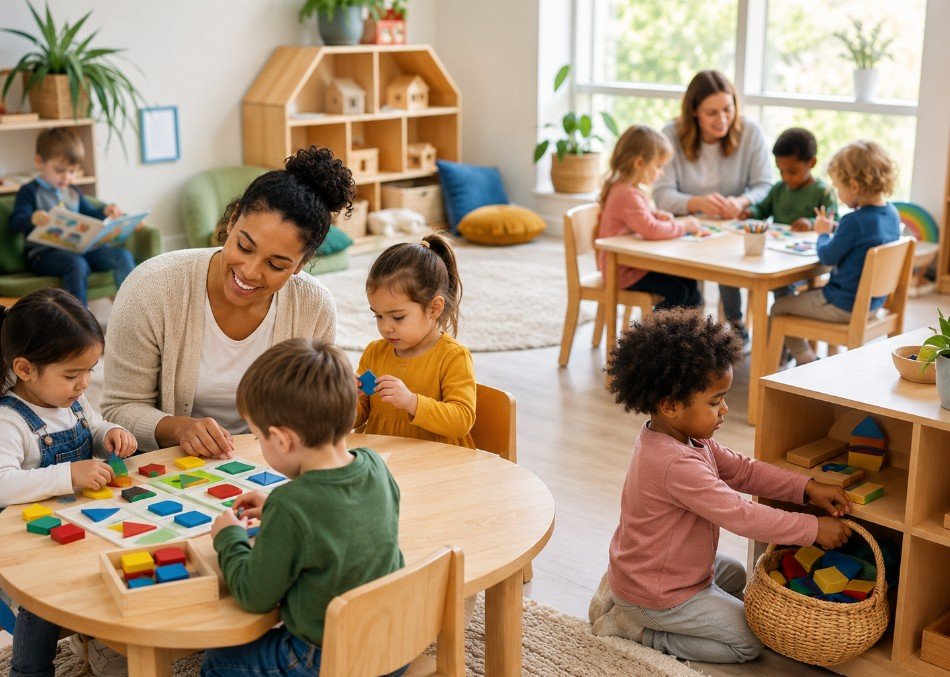

Parents often wonder what helps their child feel ready for big school. A strong school readiness program supports more than letters and numbers. It builds confidence, social skills, independence, and emotional growth. At Lakeside Creative Minds, our School Readiness Program for Preschool guides children with care, patience, and everyday learning.
Building Confidence Through Social and Emotional Growth
Before they can take part in group discussions or stay motionless during a lesson, children must feel secure and understood. We spend a lot of time teaching young children how to take turns, communicate their feelings, and use words instead of tears to resolve small conflicts. These quiet, everyday moments teach self-control, empathy, and patience long before a child ever picks up a pencil.
Learning how to handle disappointment, wait for a turn on the swing, or console a distressed friend are examples of developing emotional skills that are helpful in the classroom. Children who have emotional self-assurance are more likely to adjust to novel circumstances with significantly less anxiety. Our School Readiness Program for Preschool helps kids develop the self-assurance necessary for new routines, friendships, and classroom expectations.
Early Literacy and Numbers Woven Into Play
Without a desk, letters and numbers can take hold. Activities like counting steps on the way to the sandpit, recognizing shapes in the garden, or singing rhymes during group time naturally sow the seeds of literacy and numeracy. Children learn these ideas best when they are introduced through play rather than worksheets.
Children learn language and symbols through story time, puppet play, and simple crayon mark-making long before formal writing begins. By the time they enter a classroom, these simple daily routines have already helped them establish a comfortable relationship with words and numbers. These early skills should feel organic, fun, and related to regular play in a preschool school readiness program.
Growing Independence, One Small Step at a Time
If a child can put on their own shoes, put away their toys, or use words to ask for help, they are already one step ahead in a busy classroom. We at our preschool encourage children to try things on their own by offering guidance rather than doing things for them. Small accomplishments, like zipping up a jacket, foster true pride and self-confidence.
Decision-making is also impacted by this increasing independence. Giving kids age-appropriate options, like what to paint or which book to read, helps them develop self-confidence, a skill that will benefit them long after they are young. These everyday independence skills are promoted in our School Readiness Program for Preschool through gentle encouragement rather than coercion.
Why Do Everyday Routines Matter?
Youngsters who adhere to regular routines feel at ease and in charge. Whether it’s morning circle time, outdoor play, or rest time, children are more relaxed and less anxious when they know what’s coming up. The structure of a classroom is much easier for kids who are used to mild daily routines.
Routines also promote patience and teamwork. Once formal instruction begins, simple self-regulation exercises like lining up, waiting for a snack, or following a simple procedure pay off.
Moving Bodies, Building Skills
A child’s preparation for the classroom is influenced by both fine and gross motor skills, such as gripping a crayon, threading beads, and holding scissors. Strong hand muscles make holding a pencil much more comfortable, and good balance and coordination help with everything from sitting on a mat to navigating a busy playground.
We integrate movement into the day through outdoor games, dance, obstacle courses, and useful crafts so children can develop these skills without ever feeling like they are practicing.
The Role of a Warm, Nurturing Centre Environment
All of this is impossible without a calm, caring setting where children feel genuinely understood. Our teachers at Lakeside Creative Minds take the time to get to know each child’s personality, interests, and pace rather than following a rigid checklist. When a child feels seen, they are far more likely to try new things and take small risks.
Warm relationships with teachers also serve as an example of the kind of courteous, thoughtful interactions we hope children will carry into their first classroom. Trust built during these early years often results in the quiet confidence a child depends on later.
Working Alongside Families as Partners
It is quite common for no two children to arrive at the same place at the same time. We often talk to parents about what a child is working on at home and at the center to create a sense of connection rather than separation between the two settings. A quick chat during pick-up or a note in a communication book keeps everyone in sync.
Both parties gain from this cooperation. Families often share small victories, such as learning a new word, writing their name for the first time, or conquering a fear, and we build on these moments throughout the day. When the language used at home and in the center is the same, children feel consistency no matter where they are.
Participation in this conversation is also open to siblings, grandparents, and other caregivers. If those around a child are aware of what they are aiming for, they will have more opportunities to practice new skills in different situations, with different people, and at their own pace.
What a Typical Day Looks Like
A normal day combines lots of unstructured, kid-led play with structured moments. Before lunch, mornings could start with a group welcome song, transition into brief hands-on activities at various stations, and conclude with quiet reading. Afternoons are frequently filled with outdoor activities, artistic endeavors, and relaxation, all of which are interwoven with each child’s natural rhythm.
Teachers closely monitor the children during these times, noting who likes building with blocks, who is drawn to books, and who needs a gentle prod to try something new. These observations influence the activities for the next week, allowing the days to be flexible instead of following a rigid schedule.
A single milestone is rarely enough to get a child ready for school. It is the result of small, everyday social, emotional, intellectual, and physical experiences that build up over time. These building blocks are combined in a nurturing setting through our School Readiness Program for Preschool. To see how our early learning approach supports these crucial early years, we would be delighted to have you and your child visit Lakeside Creative Minds.
FAQs
What is a School Readiness Program for Preschool?
A School Readiness Program for Preschool helps children build the confidence, independence, social skills, early literacy, numeracy, and emotional readiness they need before starting formal schooling.
How does school readiness support early childhood growth?
School readiness supports early childhood growth by helping children manage routines, communicate clearly, solve small problems, follow instructions, and feel more confident in group learning environments.
Why are social and emotional skills important before big school?
Social and emotional skills help children make friends, take turns, handle disappointment, ask for help, and adjust to new classroom routines with less anxiety.
Can play-based learning prepare children for school?
Yes, play-based learning helps children develop early reading, counting, problem-solving, communication, and motor skills naturally and enjoyably.
How can parents support school readiness at home?
Parents can support school readiness at home by encouraging simple routines, reading together, allowing children to try small tasks independently, talking about feelings, and practicing turn-taking through everyday play.

