
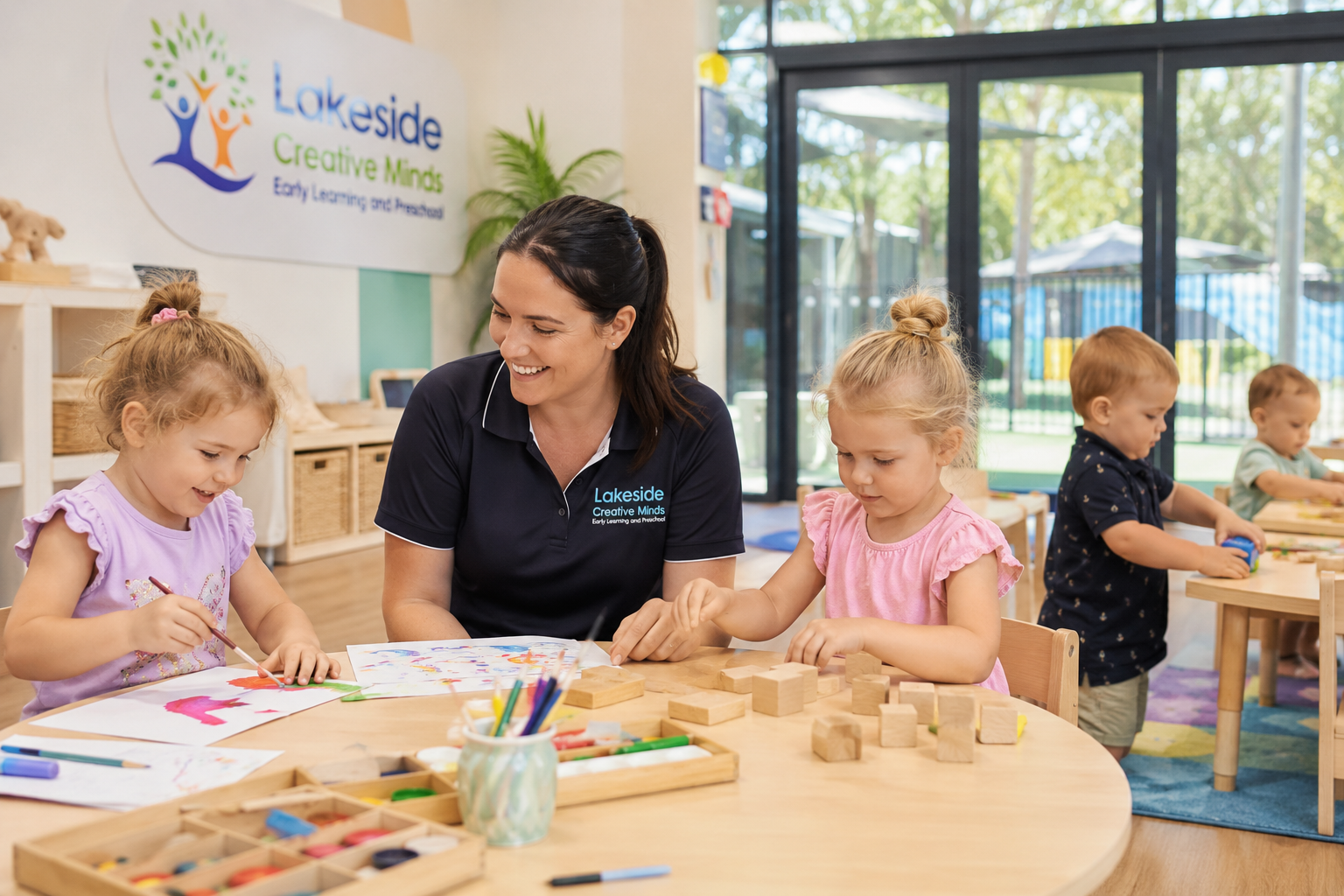

Choosing the right early learning centre is about more than finding a place for your child to spend a few hours while you manage your day. Childcare in Raymond Terrace can become an important part of your child’s early years when each day gives you opportunities for learning, play, creativity, connection, and growing confidence.
Learning Happens Through Everyday Experiences
Your child can learn from much more than structured activities. A conversation with an educator, building with blocks, helping with cooking, creating artwork, or playing outside can all become meaningful learning experiences.
At Lakeside Creative Minds Early Learning and Preschool, you can see this approach through play-based learning and experiences that encourage your child to participate, ask questions, and follow their interests. The focus stays on your child as an active learner rather than simply completing a set of activities.
This approach gives you a chance to see learning happen naturally throughout the day. Your child can practise communication while talking with others, develop early mathematical thinking while counting objects, and build problem-solving skills while working out how something fits together.
Your Child Can Learn Through STEAM Play
STEAM learning can make everyday experiences more interesting for your child.
Your child might build a structure, experiment with different materials, investigate how something moves, mix colours or take part in a hands-on project. These activities can encourage your child to think about what is happening and decide what to try next.
At Lakeside Creative Minds, STEAM experiences are included within the play-based learning approach. Your child can connect early science, technology, engineering, arts and mathematics concepts with activities that feel enjoyable and practical.
You can see the value in simple moments. If your child builds a tower that falls over, they can try another design. If a construction idea does not work, they can change it. These small experiences can help your child practise persistence without turning learning into a formal lesson.
Outdoor Experiences Become Part of the Day
Outdoor play gives your child another setting for learning.
At Lakeside Creative Minds, the outdoor environment provides opportunities for your child to move, play, create and engage with their surroundings. Your child can take part in activities that encourage physical development while also building communication and social skills.
You can see learning in something as simple as working with another child to build a raft or deciding how different materials can be used. Your child gets to make choices, share ideas and experience the satisfaction that comes from trying something independently.
Outdoor experiences can also support your child’s connection with sustainability. Everyday activities can help you introduce conversations about caring for nature and respecting the environment.
Individual Interests Can Guide Learning
Every child brings different interests, abilities and ways of learning.
Your child might spend hours drawing, while another child may prefer building, movement, stories or practical activities. When you have educators who pay attention to those interests, your child can receive learning experiences that feel relevant to them.
Lakeside Creative Minds uses individualised learning plans to support each child’s development. You can see this approach in the way activities can connect with children’s interests and developing skills.
Your child can therefore have opportunities to take the lead, make choices and become more comfortable expressing ideas. These experiences can support independence while allowing educators to provide guidance when your child needs it.
Why Is a Caring Relationship Important for Your Child?
Your child needs to feel safe and comfortable before they can confidently participate in new experiences.
Strong relationships between your child, educators and other children can create a sense of belonging. Familiar educators can learn your child’s personality, interests, routines and individual needs, allowing your child to feel known rather than simply being another name on a group list.
The importance of these relationships can be seen in everyday moments. Your child may need reassurance after a difficult morning, encouragement before trying something new, or support when learning to share with another child. Having familiar educators can make these moments easier to manage.
Creative Activities Give Your Child Room to Express Ideas
Creativity is not only about making something look beautiful.
When your child paints, creates with different textures, participates in dance or takes part in imaginative play, they can communicate ideas in ways that do not always rely on words.
Lakeside Creative Minds includes arts and creative experiences as part of its approach. Your child can experiment with materials, movement and ideas while developing confidence in expressing themselves.
You can also see creative learning connect with other areas. A story can lead to artwork. A construction activity can become imaginative play. A cooking experience can introduce counting and conversations about different foods.
Cooking Can Turn Learning Into Something Practical
Cooking gives your child a chance to learn through real tasks.
Your child can practise counting ingredients, following simple instructions, talking about textures and colours, and waiting for their turn. They can also become familiar with different foods and learn to make choices about food.
At Lakeside Creative Minds, cooking experiences form part of the centre’s learning opportunities. These activities allow your child to participate rather than simply watch.
You can continue this type of learning at home by giving your child small responsibilities in the kitchen, such as washing fruit, stirring ingredients or helping to count items.
Why Does Feeling Safe Matter for Your Child?
Your child’s emotional wellbeing matters throughout the day.
Your child needs opportunities to move, rest, communicate feelings, build friendships and receive support from trusted educators. Learning becomes easier when your child feels comfortable and connected.
The Early Years Learning Framework provides an important foundation for the learning approach at Lakeside Creative Minds. The framework focuses on areas such as identity, community, wellbeing, learning and communication.
You can see these areas within everyday experiences. Your child can build a sense of identity by making choices, develop community connections through group play, practise communication during conversations and strengthen learning skills through hands-on activities.
Families Can Be Part of the Learning Journey
Your child’s learning does not stop when you leave the centre.
When you understand what your child has been interested in during the day, you can continue those conversations at home. A simple question about what your child built, cooked, painted or played can encourage them to talk about their experiences.
You can also share your child’s interests and routines with educators. This two-way communication helps create stronger connections between your child’s experiences at the centre and at home.
For you, this can make the early learning journey feel more connected and personal.
What Can You Look For in an Early Learning Centre?
When you visit an early learning centre, you can look beyond the rooms and facilities.
You can pay attention to how educators speak with children, whether children are encouraged to make choices, how outdoor learning is used and whether the environment feels welcoming.
You can also ask how learning is planned, how individual interests are supported, how families receive updates and how wellbeing is included in the daily routine.
At Lakeside Creative Minds, the focus is on creating a child-centred environment where play, learning, creativity, relationships and wellbeing come together.
Frequently Asked Questions
1. What makes an early learning centre more than childcare?
Your child can receive more than supervision when the day includes purposeful play, learning experiences, creative activities, outdoor time, social connections and emotional support.
2. How does STEAM learning support your child?
Your child can practise problem-solving, creativity, early mathematics and critical thinking through practical activities involving construction, experimentation, art and play.
3. Why is outdoor learning important?
Outdoor experiences give your child opportunities to move, communicate, work with others, make choices and engage with the natural environment.
4. How does the EYLF support your child?
The Early Years Learning Framework provides a foundation for learning and development across areas including identity, community, wellbeing, learning and communication.
5. Why are relationships with educators important?
Your child can feel more secure when familiar educators understand their personality, interests, routines and individual needs. These relationships can support confidence and participation.
6. How can cooking support early learning?
Your child can practise counting, listening, communication, coordination and following instructions while participating in practical cooking experiences.
7. How can families support learning at home?
You can continue conversations about your child’s day, encourage their interests through simple activities and share information with educators about your child’s routines and interests.
A meaningful early learning experience is not measured only by how many hours your child spends at a centre. You can look at what your child gets to experience during those hours: opportunities to play with purpose, build relationships, express ideas, spend time outdoors, solve problems and develop confidence. When those experiences are part of everyday life, your child can carry the value of each day well beyond the centre.

