
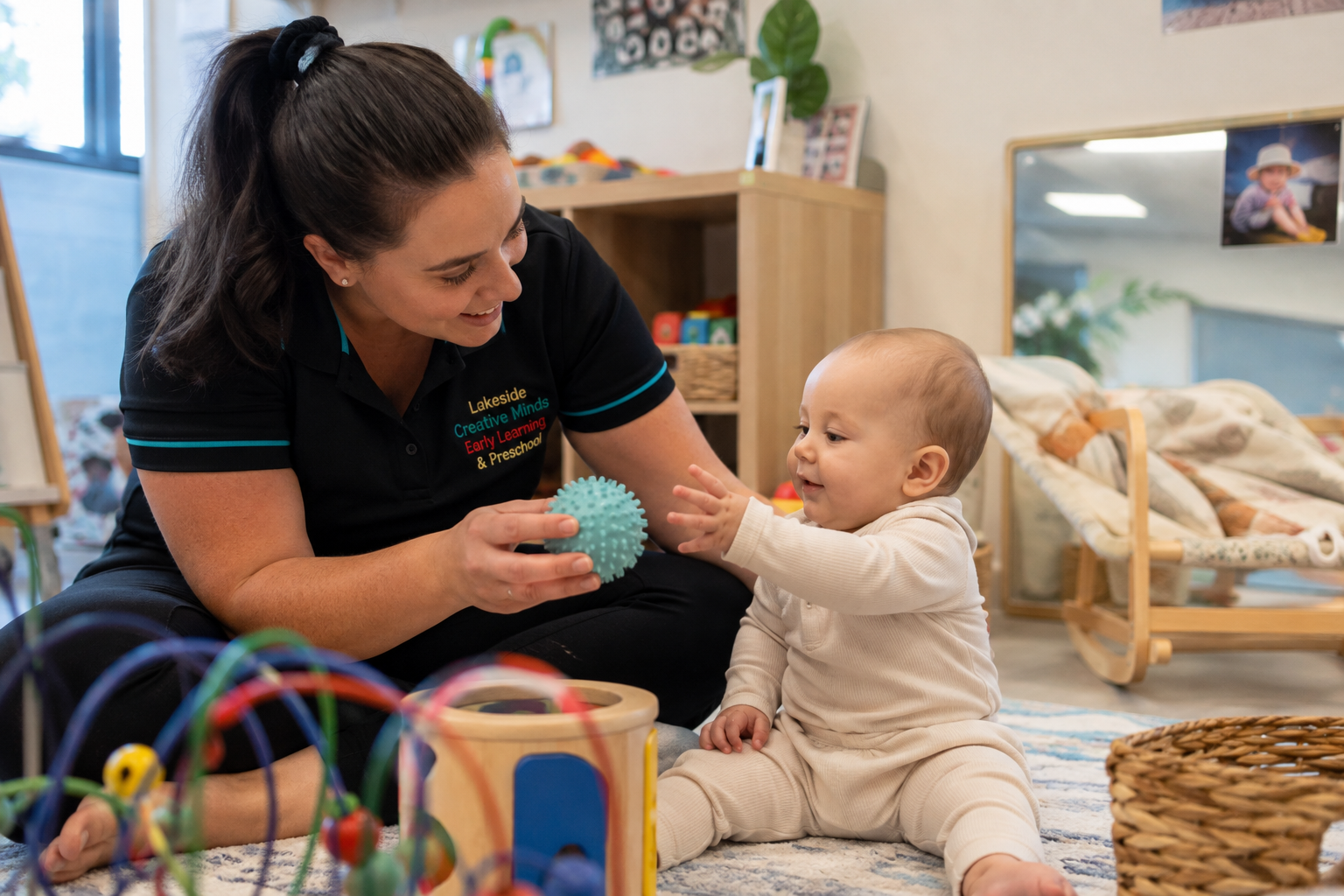

A lot is happening in your baby’s world, even when the day looks quiet. A familiar educator’s voice, a smile across the room, a little time to reach for something interesting, or the comfort of knowing what comes next can all hold meaning for your baby. An Infant program is built around these moments. Your baby is given time to form trusting relationships, respond to their surroundings, communicate in their own way, and grow through experiences that feel natural rather than rushed. Because in these early years, it is often the little moments that help your baby feel confident enough to take the next step.
Why Are Small Everyday Moments Important During Your Baby’s Early Years?
Your baby does not need a big activity to have a meaningful learning experience. Sometimes, it can be as simple as feeling comfortable with a familiar educator, becoming interested in a new sound, reaching for a toy, or enjoying a few moments of shared interaction.
When these experiences happen regularly, your baby gradually becomes more familiar with the people and surroundings around you. You begin to feel more comfortable expressing your needs, trying something new, and responding to the people who care for you.
That is why the little moments deserve attention. For your baby, an ordinary moment can be another opportunity to feel secure, build a relationship, communicate, and grow in confidence.
Familiar Relationships Help Your Baby Feel Safe and Comfortable
Starting childcare can be a big change for your baby. New faces, a different room, and time away from home can take a little getting used to. Having familiar educators around can make those new experiences feel more comfortable.
When an educator gets to know your baby’s expressions, sounds, movements, and usual ways of communicating, they can respond with greater understanding. Over time, your baby may begin to recognise their voice, smile when they come closer, or settle more easily in their care.
At Lakeside Creative Minds Early Learning and Preschool, building familiar and trusting relationships is an important part of caring for your baby. In a small centre setting, your baby has regular opportunities to know the educators around them, form connections, and feel comfortable as part of the day.
Small Interactions Can Support Early Communication
Your child may not have many words yet, but communication is already happening in many ways. A look, a smile, a little sound, or a movement can tell an educator that your child is interested, curious, tired, or ready to connect.
When your educator notices these little signals and responds, a natural back-and-forth begins. Your child makes a sound, the educator responds, and your child may respond again. With these simple exchanges happening throughout the day, your child has more opportunities to listen, respond, and express themselves.
At Lakeside Creative Minds Early Learning and Preschool, these everyday interactions are part of creating warm and responsive relationships. Your child does not need to sit through a formal lesson to begin developing communication. Sometimes, meaningful learning starts with something as simple as knowing that someone is listening.
Small Experiences Can Support Early Development
Your baby’s development happens gradually.
A few minutes reaching for a toy can support physical coordination. Looking at a new object can encourage attention. Listening to different sounds can support sensory awareness. Responding to an educator can encourage early communication.
Your baby can experience these opportunities naturally throughout the day.
At the centre, age-appropriate play, sensory experiences, movement, and communication are part of an EYLF-aligned approach to infant learning.
The focus remains on giving your baby opportunities that match their stage of development rather than expecting every baby to progress in the same way.
Why Consistency Can Make a Difference?
Your baby may feel more comfortable when familiar patterns are part of the day.
This does not mean every moment needs to follow a strict schedule.
Your baby’s individual needs still matter.
At the centre, your baby’s home routine can be considered as part of their care. Sharing information about your baby’s preferences, comfort cues, and usual patterns helps educators understand what feels familiar to your baby.
Small Moments Can Support Emotional Wellbeing
Your baby cannot always tell you when something feels unfamiliar or overwhelming.
You may notice it through crying, facial expressions, body movements, or changes in behaviour.
A responsive educator can notice these signals and provide appropriate support.
Sometimes your baby may need a quiet moment. Sometimes your baby may want closeness. At another time, your baby may be ready to return to play.
Being able to respond to these individual cues can help your baby experience care that feels attentive and respectful.
Your Baby Does Not Need Constant Activities
Your child does not need to move from one activity to another all day to have a meaningful experience. Sometimes, your child may simply watch an educator, become interested in what another child is doing, spend time with a familiar resource, or enjoy being outside in a calm space.
These quieter moments give your child time to take in what is happening around them. Your child can listen, observe, make choices, respond, and become comfortable with their surroundings without feeling rushed.
At the centre, your child is given opportunities to enjoy both active experiences and peaceful moments. This balance allows your child to follow their own interests, build confidence, and develop naturally through the experiences that happen throughout the day.
How Everyday Experiences Help Your Child Build Confidence?
Your child may not feel comfortable with a new educator straight away. At first, your child may simply watch, listen, and take in what is happening around them. As your child becomes familiar with the educator, you may notice a smile, a response to their voice, a reach towards them, or a growing willingness to join in.
You may notice the same gradual progress during play. Your child might watch another child using a resource before deciding to have a turn. Your child may touch it, pick it up, put it down, and try again. Having time to do this without pressure allows your child to become more confident with each attempt.
These changes can look very simple, but they can tell you a lot about your child’s growing confidence. When your child feels comfortable enough to respond, participate, and try something new, you can see how everyday experiences are supporting their development.
How an Infant Program Makes Everyday Care Part of Learning?
Your child learns best when learning feels like a natural part of the day. A conversation with an educator, joining in with play, watching what is happening nearby, or having time to try something independently can all give your child a chance to learn.
An Infant Program brings these experiences together with the care your child receives each day. Your child can build relationships, develop communication, practise movement, experience different textures and sounds, and become more confident in familiar surroundings—all without turning the day into a series of formal lessons.
At the centre, your child’s experiences are guided by the Early Years Learning Framework. Your child is given opportunities to belong, be and become through warm relationships, play, care, and experiences that follow their individual pace and interests.
Why Does Your Child’s Everyday Experiences Matter?
Your child does not need a day packed with activities to learn something valuable. In the early years, learning can happen while your child is playing, watching, listening, moving, communicating, or simply spending time with a familiar educator.
At the centre, your child is given time to take part in experiences without being hurried from one activity to another. Your child can follow their interests, try something new, repeat an experience, or step back when they need a little time.
With responsive educators and a calm, nurturing environment, your child can gradually become more comfortable with others and more confident in their surroundings. These everyday experiences give your child the freedom to learn naturally, one experience at a time.
Giving Your Baby Time to Grow at Their Own Pace
Your baby does not need to reach every milestone at the same time as another child.
You may notice one area of development before another. Your baby may be particularly interested in sounds, movement, faces, textures, or social interaction.
An infant setting should give your baby room to develop naturally while educators observe, respond, and provide appropriate experiences.
At the centre, the focus is on knowing your baby as an individual and providing nurturing care that respects their needs, relationships, routines, and developing abilities.
That is why the smallest moments deserve attention.
Your baby’s early years are built day by day not only through the big milestones, but through the repeated experiences of being heard, comforted, supported, encouraged, and cared for. At Lakeside Creative Minds Early Learning and Preschool, these everyday experiences are valued as meaningful parts of your baby’s early development.
Frequently Asked Questions
1. Why are small everyday moments important for your baby?
Small everyday moments give your baby repeated opportunities to build trust, communicate, develop relationships, practise skills, and feel emotionally secure.
2. How do everyday interactions support your baby’s learning?
Your baby can learn through responses, sounds, facial expressions, movement, sensory experiences, play, and relationships without needing formal lessons.
3. Why are consistent educators important for your baby?
Familiar educators can learn your baby’s individual cues and provide responsive care, helping your baby become comfortable with the people and environment around them.
4. How does an EYLF-aligned approach support infant learning?
An EYLF-aligned approach connects learning with relationships, play, communication, wellbeing, and everyday experiences that are appropriate for your baby’s stage of development.
5. Why does your baby need time to develop at an individual pace?
Every baby develops differently. Giving your baby time to practise, repeat experiences, and respond naturally allows development to happen without unnecessary pressure.

